Your AI Isn't the Problem. Your Context Is.
 8 min
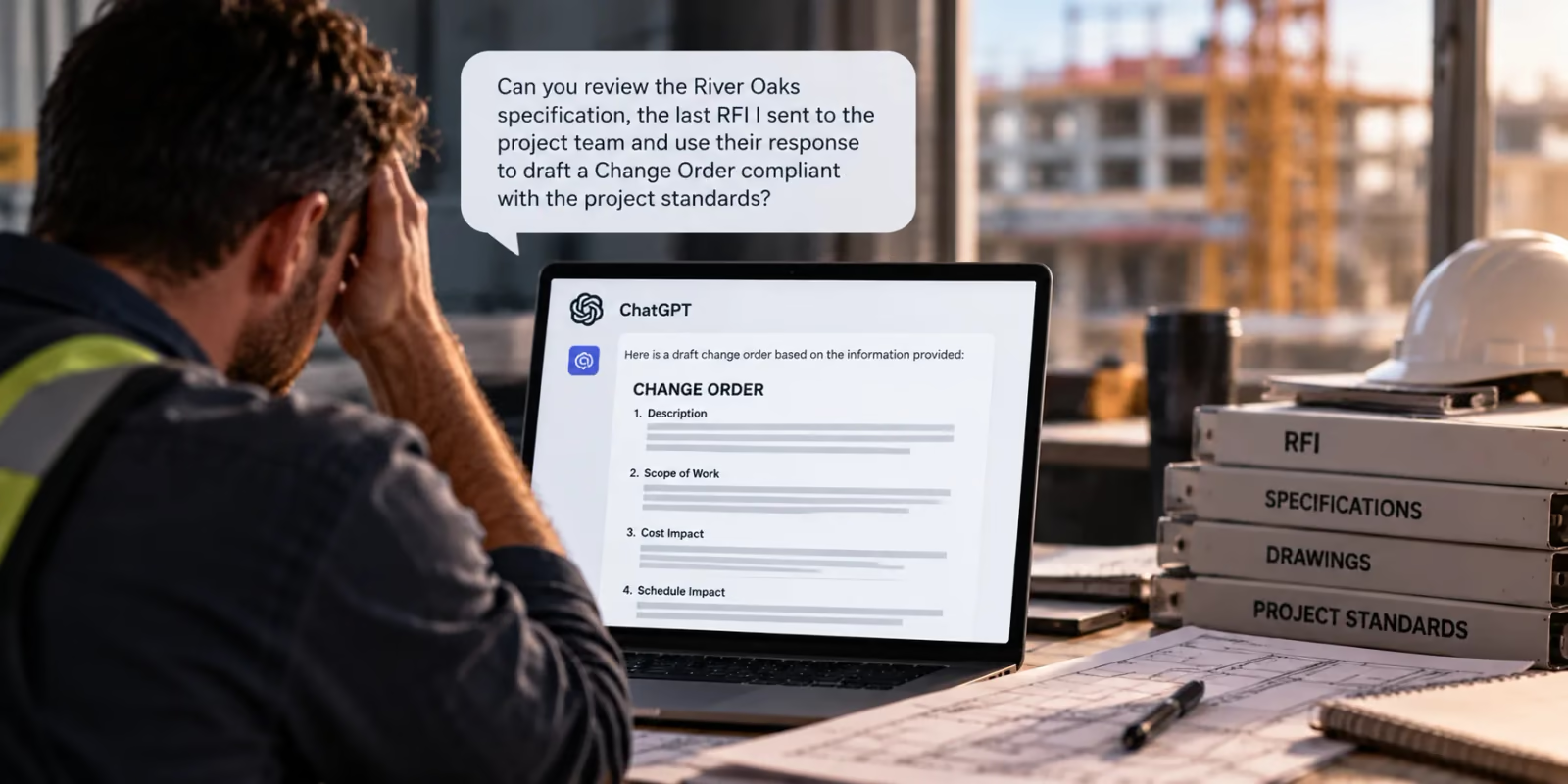
Try this prompt out in ChatGPT:
Can you review the River Oaks specification, the last RFI I sent to the project team and use their response to draft a Change Order compliant with the project standards?
If you did, you'd realise it didn't work.
It might know what an RFI and Change Order are and it might produce something that looks plausible, but it doesn't know the project specific change order template.
The answer is generic or it states it doesn't have access to project files or email content. It needs you to provide the context so that it can complete the task.
And even when I give it the specification, the RFI, the response and the Change Order template, it still doesn't give me the output I need.
Because there is a difference between having the information and understanding how the work gets done.
The reason why is that it is still missing tacit information. The template format I use, the project standards, the subtle way in which I format and write my RFIs. That knowledge lives in my head and is revealed if you saw me doing the work.
What I am highlighting here is that ChatGPT, Claude or Microsoft Copilot, generic LLM tools, have a gap. Every time I make a request, they give me an answer that's 60% of the way there. It's helpful but is missing important information because it needs more context.
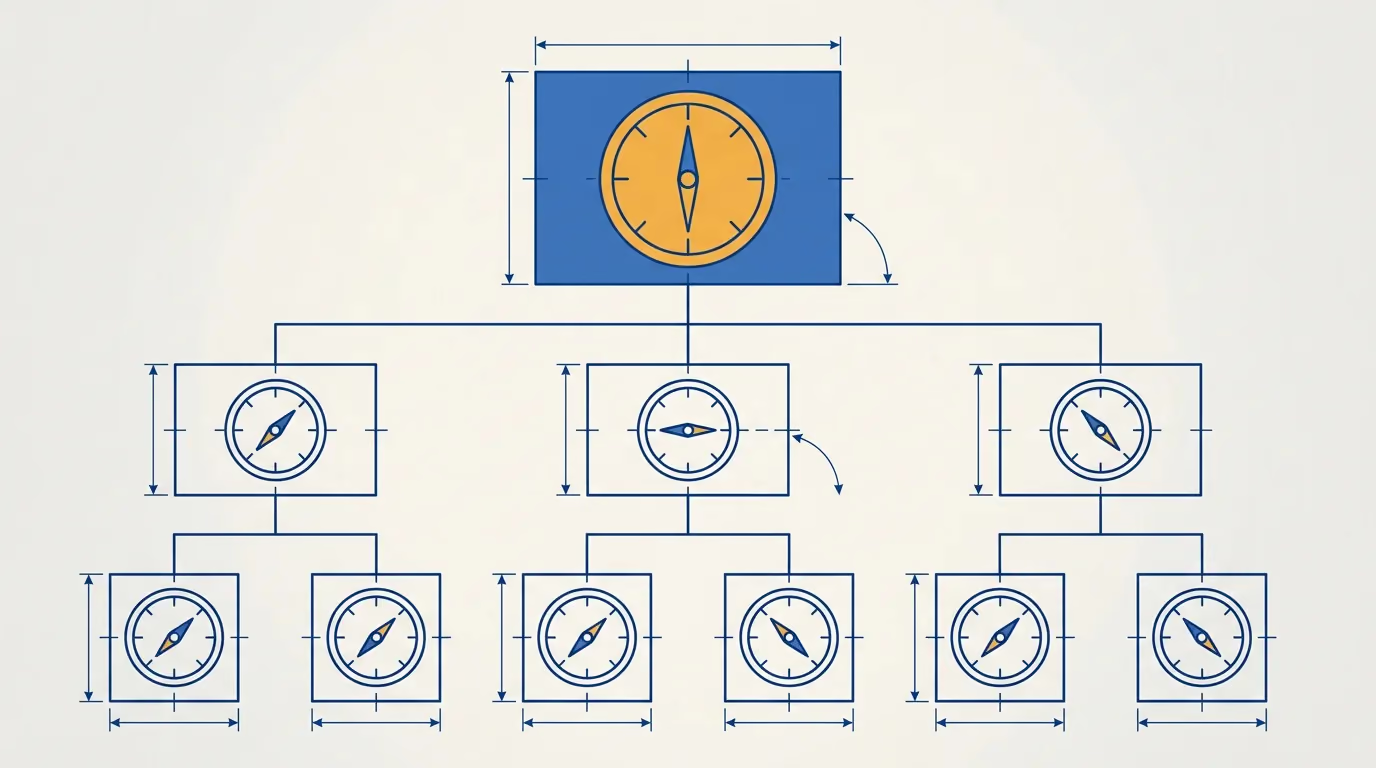
To work for the trades it needs to understand three levers:
Lever 1: The construction industry
Our industry has its own vernacular, processes and terminology. You need to understand what an RFI, NCR, submittal, change order or pre-pour inspection actually means before you can do useful work.
But knowing the industry is only the starting point.
Lever 2: Company context
Each company has its own unique operating standards and conventions.
Two contractors can perform the same task using completely different processes. One might manage RFIs through Procore, another through a spreadsheet. One might have a formal review process for Change Orders, another might rely heavily on a project manager's judgement.
Neither is necessarily more "correct," it's simply how that company operates.
Lever 3: Project context
Project context can override company context.
Your company may have a standard Change Order process, but a particular owner may require a different format. A project specification may introduce requirements that don't exist on another job. A project manager may have their own expectations for how information is presented.
So the same task can have a different "correct" answer depending on the project. AI needs to understand all three layers of context. Without them, it can provide an answer, but not necessarily the right answer for this company on this project.
Generic AI is like a new employee who hasn't gone through the onboarding yet. Sure they understand Lever 1, but they don't yet know how the company works or how our projects are run.
And this is where most generic AI tools fail.
A new employee has a manager, colleagues, meetings and months of working alongside experienced people to learn this context. AI tools on the other hand don't have an equivalent process for continuously learning how your organization actually works.
So we started asking a different question:
What if AI could be onboarded like an employee?
What if we could teach it how the company works, how the project works and what experienced people pay attention to.
At Pelles, it's a challenge we saw first hand.
AI can be an incredibly valuable tool but it needs to have the right information, be connected to your project systems and understand how you work so that it can save you time.
To do that we realised we needed something different: a Trade Operating System.
A layer between the AI model and the work itself that captures the company's knowledge, project context, workflows, templates and decision history.
The model provides the intelligence. The operating system provides the context.
There are two ways to build this context.
One is to let the AI learn through the work, like a new employee. The other is to proactively onboard it to a project before it starts working.
Let me show you how this actually works.
Learning on the job
Our first track is Pelles Core.
It starts with the assumption that the best way for AI to understand your work is to work alongside your team.
It works as a new AI employee that can do three things:
- DoubleCheck. You can ask it a question and it finds answers referencing your drawings, spec, contracts, schedules and addendums.
- Workflows. It can complete common tasks such as reviewing contracts, comparing quotes, building schedules and preparing submittals.
- Compare. It compares sheets, aligns drawings and highlights changes across revisions and addendums while summarizing what's changed in your scope.
Because it's connected to your systems it can provide answers using your project templates and standards and queries your knowledge base, not generic information on the internet.
This is the difference between retrieval and context.
Retrieval gives the AI the document. Context tells it which document matters, how it should be interpreted and what the output needs to look like.
And because it's an employee tuned to you, after a couple of months it starts to learn how you work, capturing information on Lever 2: Company context and Lever 3: Project context. The way it does so is through something called a decision trace.
A decision trace isn't simply a record of what someone asked AI to do. It captures the conversation, the decision that followed, the context behind it and, where relevant, the correction or preference an experienced person provided.
That's important because this is where much of the industry's tacit knowledge lives.
Capturing tribal knowledge
So much of what we do in construction is learned on the job.
On River Oaks we might have specific checks like:
- Always check for trimmer bars during the pre-pour inspection.
- Bob wants critical path activities reviewed at the beginning of every Monday meeting.
- Revised shop drawings need changes highlighted against the previous revision before they're circulated.
These rules don't exist in the specification but they are still part of how the project gets done.
This creates risk because much of this information isn't captured in a way that survives when an employee leaves. Instead it lives in their head and when they leave, it's only partially transferred (at best) in an offboarding meeting and a list of files shared on Microsoft Excel.
That impacts delivery and quality of work.
The best way to run offboarding would be to hire a new employee and have them shadow the person leaving for 3 months. That way they'd know how each client works, the challenges on the project, where the data lives and what to pay attention to.
That's effectively how expertise is transferred in construction today: through observation, repetition and working alongside experienced people.
AI has the potential to do something similar, but continuously and at scale.
It is connected to your systems and captures every request, every question and every revision to understand how you work.
It knows from the meeting transcripts on the River Oaks project that Bob wants to review the critical path tasks at the start of every meeting while Sally is more concerned with reviewing the risk register and mitigations.
That context is stored in its memory against Lever 3: Project River Oaks. It does this across your organization, building memory and decision traces to understand how you do work but also why and, over time, is able to offer suggestions proactively as you complete tasks.
For example on Monday morning it can send you an email with:
- Status of critical path activities
- Risks associated and mitigations
That way you're prepared for Bob and Sally without having to go in and set it all up yourself.
Employee onboarding
Pelles Build takes the opposite approach. Instead of waiting for the AI to learn through the work, we proactively onboard it.
Over the course of a 2 hour workshop we ask you questions to understand your business, your workflows, sources of wasted time and what you need.
The goal isn't to document everything the company knows, it's to identify the small number of workflows, decisions and sources of friction where better context could create the most value.
We share this with your AI system so that it knows what's important, the templates which matter, how specific clients operate or bottlenecks and areas that require support.
After this we give you two things:
- Custom AI Apps designed to help people complete specific workflows
- Custom AI Agents designed to continuously monitor information, make decisions within defined boundaries and take action.
At this stage the AI has not only Lever 1: The construction industry but also Lever 2: Company context and Lever 3: Project context and over time, that context compounds. Every decision trace creates another piece of organizational knowledge that can be used to improve workflows, build new AI apps or deploy new agents.
And the best part?
This makes organizational knowledge durable. Where that information is appropriately captured and governed, it can remain with the company rather than being lost when an employee leaves.
Use AI that knows your business
AI isn't going to eliminate the need for people who understand the work.
But people who combine AI with deep company and project context will get superpowers.
When you use AI it's useful to ask yourself three things:
1. Is this learning every day from my people?
In the same way that an engineer with 5 years experience is more valuable than a new graduate, I want my AI to improve every time we use it.
So don't just ask whether the AI can answer questions, ask whether every interaction makes the system more useful to the next person who encounters the same problem.
2. Am I capturing tribal knowledge?
A good test is to ask your AI what it knows about a specific project that requires contextual knowledge. That's questions like:
- Who needs to be involved in a decision?
- What does the project manager care about?
- What do we always check before a pre-pour?
- What are the recurring bottlenecks?
This is all information that usually lives in someone's head.
3. How do I build on top of my AI?
It isn't enough to hire a chatbot like ChatGPT or Microsoft Copilot. I want to extend the platforms to automate most common use cases.
The bigger opportunity is building workflows and agents around the underlying context so the AI can move from answering questions to completing work.
And the best AI tools have people I can talk to, explain my problems to and are able to design AI apps or AI agents to solve them.
It's needed because we aren't developers. We don't know how to make a GPT or a skill for automations, and having a team we trust can save hours of busy work.
The next advantage in construction will come from having an AI system that understands how your organization actually works.
Because construction knowledge isn't just what's written in the drawings, specifications and contracts. It's also the decisions people make every day to turn those documents into a project.
At Pelles this is what we're building. Chat to us if you're ready to get started.