The Objective Layer: How AI-Native Firms Run
 Matan Weksler9 min
A neighborhood grocery store and a Walmart Supercenter sell mostly the same things. Milk, bread, batteries, detergent. Stand in either one and the products look interchangeable. What is not interchangeable is everything you cannot see. One of them runs on a logistics network that tracks pallets from supplier to shelf, forecasts demand store by store, moves stock ahead of a storm, and negotiates with suppliers using data the grocer will never have. The shelves match, but the organisms behind them could not be more different.
That gap did not come from Walmart having smarter people. It came from coordination, measurement, and optimization at a scale the grocer could not reach. And it compounded: every year the network learned more, so every year the gap widened.
AI is about to create the same divergence in cognitive and operational capacity, and it will happen inside industries that have never seen it. As intelligence becomes cheap and available to everyone, it stops being the differentiator. What differentiates firms is whether they can coordinate thousands of agents, models, systems, and people around a coherent objective, measure whether it is working, and improve. Today, organizations manage people and tasks. Tomorrow they will manage objectives and optimization systems. Doing that requires an objective layer, something deeper than a task manager or an agent framework.
Part 6 of our series on the AI-native construction firm. Earlier parts are Harness or Fine-Tune?, Recursive Self-Improvement in 2026, Intelligence Is Nearly Free, Cheap Intelligence Makes Objectives Scarce, and AI Misalignment Starts in Your Org Chart.
Why the gap between firms is about to widen
The gap widens because intelligence is becoming a commodity available to every firm at the same price, so the difference between firms shifts entirely to how well they coordinate it, and coordination advantages compound.
Consider two mechanical contractors of similar size, both using AI. In the first, estimators open a chat window and ask questions about the spec. PMs use an assistant to draft RFIs. The controller runs a model over invoices. Each person hands individual tasks to individual tools. Productivity is up, maybe meaningfully. But nothing connects. The estimating assistant does not know what the closeout data says. The RFI drafter does not know which questions the field asked three times last month.
In the second firm, the same tasks run, but toward a stated objective. Every bid is measured against closeout margin, and every RFI against repeat questions from the field. A correction a PM makes becomes a signal that adjusts the workflow. Agents coordinate across estimating, operations, and the field because they are pointed at the same outcome and measured against the same reality. That firm is running a different kind of organization, not a ten percent faster version of the old one.
Two firms can buy the same models and the same tools. Only one of them knows what the tools are for.
The AI-native contractor argument was about owning the loop. This is what the loop is for. A company that can coordinate thousands of autonomous agents around a coherent objective will operate at a fundamentally different scale from a company where humans manually assign tasks to individual AI systems. And the gap grows as those systems begin improving themselves, because self-improvement toward a clear objective compounds and self-improvement toward nothing in particular just produces noise.
From managing people and tasks to managing objectives
Today's organizations are structured to manage people and tasks; the AI-native organization is structured to manage objectives and the systems that optimize toward them.
Almost every management tool in existence, from the org chart to the Gantt chart to the ticketing system, exists to answer one question: who is doing what, and is it done? That made sense when people did the work and human attention was the constraint. Managing meant assigning tasks to people and checking on them.
When agents do most of the execution, that question stops being the important one. The tasks get done. What matters is whether they were the right tasks, pursued toward the right end, measured against the right reality. Management moves up a level, from "who is doing what" to "what should this system become better at achieving, and is it?"
Some objectives will be pursued by general models wrapped in sophisticated harnesses. Others will justify specialized models, continuously fine-tuned on the firm's own corrections. Still others may be pursued by systems capable of recursively improving their own ability to achieve the outcome. We have written about why both architectures depend on the same thing. The point here is what that does to the organization. It needs a place where the objectives live, get measured, and stay coherent regardless of which system happens to be pursuing them this quarter.
What an objective layer is
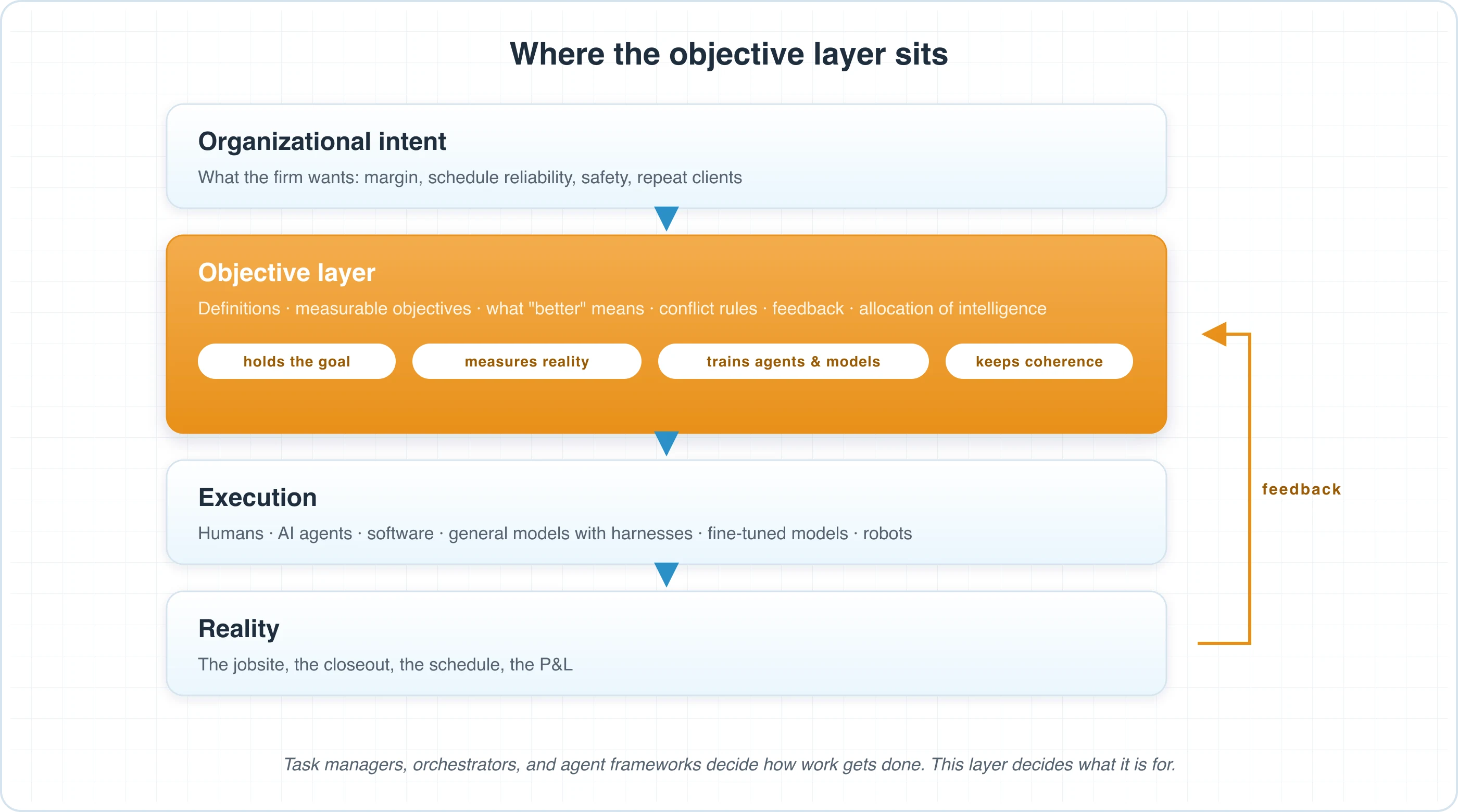
An objective layer is a representation of what the organization wants, how success is measured, how competing goals interact, how reality feeds back into those goals, and how intelligence should be allocated to improve the outcome.
Task management sits downstream of it. Orchestration decides how agents hand work to each other rather than what the work is for, and an agent framework makes agents easier to build while saying nothing about what they should pursue. Each of those is necessary. None of them holds the objective.
In practice an objective layer lets an organization do ten things, which fall into three groups.
Define.
- Define what it is actually trying to achieve, in terms precise enough to act on.
- Translate strategy into measurable objectives, so "grow negotiated work" becomes numbers with a source.
- Encode what "better" means, so any system pursuing the objective knows how it is judged.
- Decompose objectives into coordinated work across teams, agents, and systems.
Align and measure.
- Align humans, AI agents, software, models, and robots around those objectives instead of around task lists.
- Continuously measure reality against the desired outcome, not once a quarter.
- Create the feedback signals required to optimize agents and fine-tune models, so improvement has a direction.
Adapt.
- Adapt plans, models, and resource allocation as conditions change.
- Enable systems to improve how they pursue an objective without losing alignment with the objective itself.
- Scale organizational intelligence without losing coherence, so a thousand agents behave like one firm.
The last group is what separates this from a dashboard. An objective layer is not a place to look at metrics. It is the mechanism that keeps a self-improving system pointed at the right thing while it improves.
What it looks like inside a construction firm
Inside a contractor, an objective layer connects the bid, the job, and the next bid into one measured loop, so every agent and person in preconstruction, operations, and the field is pursuing the same stated outcome.
Take a firm whose stated objective is margin on completed work, with schedule reliability and safety as constraints that cannot be traded away. Under an objective layer:
- Preconstruction agents review bid sets against scope-gap patterns drawn from closeout data, because estimates are measured by what they earned at closeout, not by whether they won.
- Operations agents track revisions, draft RFIs, and review submittals, and every PM correction is captured as feedback, because "better" is defined as fewer field escalations, not faster ticket closure.
- The field feeds daily reality back, meaning what got installed, what got reworked, and what stopped. That data updates the measurement, which updates what the estimating agents look for next.
- Leadership sees the objectives, the trade-offs, and where the system is drifting. When the market shifts and the margin target needs to move, the change propagates to every agent at once instead of through a quarter of meetings.
The tools here are not exotic. The document Q&A and revision comparison in Pelles Core already do the execution work. What the layer above them adds is the connective tissue. It holds the reason those tools are running, the measurement that says whether they are helping, and the feedback that makes them sharper. Agents built in Pelles Build connect that loop to live Procore and Autodesk project data.
Why the objective is the most important part of the system
If a system can continuously improve its ability to achieve an objective, then the quality of that objective, and the mechanisms that measure and maintain alignment with it, become the most important parts of the system.
That is no longer a thought experiment. The recursive self-improvement evidence showed that every loop which compounded did so against an honest, protected evaluator, and every loop that failed was beaten through its scorer. The misalignment post showed the organizational version, a chain of departments that each hit their number while the job loses money. Both are failures of the objective rather than of the model.
This inverts how most firms think about AI. The instinct is to evaluate models, pick tools, and compare vendors, because that is what looked like the hard part. But the models are converging, the tools are multiplying, and the cost of intelligence is approaching zero. The organization that owns the definition of "better," keeps it honest with feedback from reality, and holds every agent to it is the Walmart in this story. The one that hands tasks to tools and hopes is the grocer.
What Pelles AI is building
Pelles is a Trade Operating System: AI that runs your projects the way your best people would — on your own drawings, specs, and contracts, not on general knowledge. The objective layer is the part of it that decides what "the way your best people would" means, measures whether the work is getting there, and keeps that definition honest as conditions change.
Construction is the right place to build it, for a reason. The objectives are real and measurable, starting with margin, schedule, safety, and rework. The feedback from reality is unambiguous, because a slab either got poured on schedule or it did not. And the coordination problem is brutal, spanning estimators, PMs, superintendents, subs, suppliers, and now agents, all working from documents that change weekly. If an objective layer can hold a contractor together, it can hold anything together.
The future will not be constrained by our ability to generate intelligence. As intelligence approaches zero cost, the advantage moves to whoever can point it at the right objective, measure whether it is succeeding, and continuously improve the system pursuing it.
That is the layer we are building into the Trade Operating System. If your firm is ready to write down what it is optimizing for, request a demo and we will map your objectives with you, with your bid history and your live projects on the table. Or start with the execution layer and explore Pelles Core today.
Frequently asked questions
What is an objective layer?
An objective layer is the part of an organization's system that holds what the organization wants, how success is measured, how competing goals interact, how reality feeds back into those goals, and how intelligence should be allocated to improve the outcome. It sits above task management, orchestration, and agent frameworks. Those tools decide how work gets done. The objective layer decides what the work is for, keeps every human, agent, model, and system aligned to it, and produces the feedback signals that let the whole system improve without drifting from the goal.
How is an objective layer different from OKRs or a project management tool?
OKRs are a way of writing goals down for people to read a few times a year. A project management tool tracks tasks that people assign to each other. An objective layer is a live system. It encodes what better means in terms a machine can act on, decomposes objectives into coordinated work for both humans and agents, measures reality against the target continuously, and generates the training signal that improves the agents and models pursuing the goal. It is built for a world where most execution is automated and the scarce input is a well-defined, well-measured objective.
Why will AI widen the gap between companies rather than level it?
Because the same intelligence is available to everyone, so intelligence itself stops being the differentiator. What differs is coordination. A firm that can align thousands of autonomous agents around a coherent, measured objective operates at a different scale from a firm where people hand individual tasks to individual AI tools. It is the difference between a local grocery store and Walmart's logistics network, with similar products but entirely different levels of coordination, measurement, and optimization. And because AI systems improve against the feedback they are given, the firm with the better feedback loop gets better faster, so the gap compounds.
What will organizations manage in an AI-native future?
Objectives and optimization systems instead of people and tasks. Some objectives will be pursued by general models with sophisticated harnesses, others by specialized models continuously fine-tuned for that outcome, and eventually some by systems that recursively improve their own ability to hit the target. Managing that means deciding what each system should become better at achieving, measuring whether it is, and reallocating intelligence and resources as conditions change. The people in the organization move up a level, from executing work to defining and governing what the work is for.
What is Pelles AI building?
Pelles is a Trade Operating System: AI that runs your projects the way your best people would — on your own drawings, specs, and contracts, not on general knowledge. Today that starts with the execution layer: Pelles Core reads the bid set, answers questions from the documents, and compares revisions, and custom builds fit agents to a firm's own process. The objective layer is the direction: one place that holds what the firm is trying to achieve, measures reality against it, and keeps every person and agent pointed at the same outcome.