Intelligence Is Nearly Free. The Jobsite Isn't.
 Matan Weksler7 min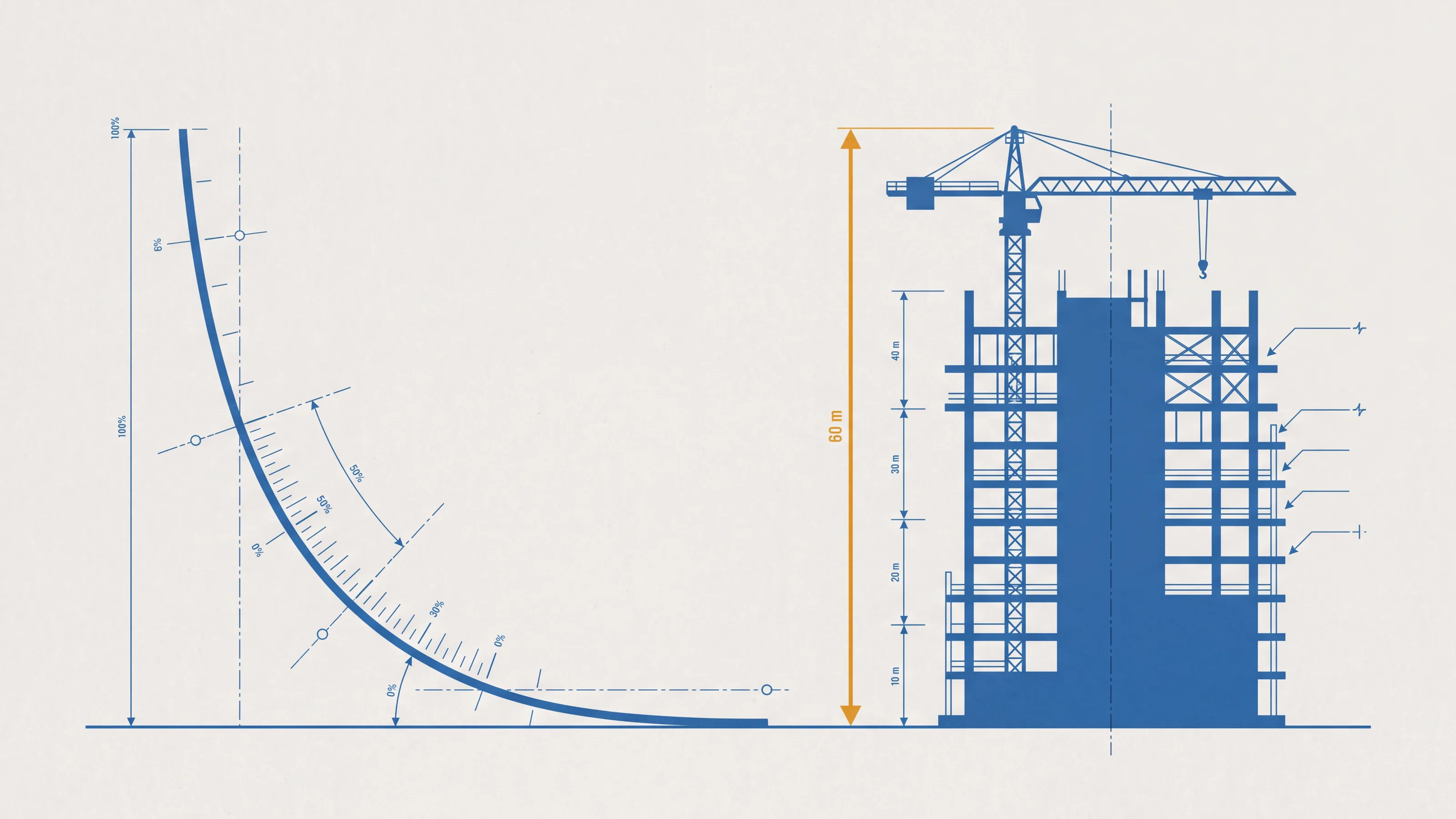
In 1800, nearly every yard of cotton cloth was still woven by hand. A century later it was so cheap that nobody asked whether cloth could be made. The question had become what the mills should make, for whom, and how much. The machines had answered the first question so thoroughly that it stopped being interesting. The second one built empires.
We are living through the same inversion, except the thing getting cheap is thinking. The Industrial Revolution gave humanity machines that could produce, move, and manipulate physical goods at a scale no individual could match. AI is doing the same for reasoning, analysis, planning, software, communication, coordination, and decision-making. And it has an economic consequence that most people have not yet priced in: the cost of intelligence is approaching zero.
The marginal cost of another analysis, another plan, another piece of software, or another decision is collapsing. As it does, execution becomes abundant, and the bottleneck moves from whether a problem can be solved to what all of this intelligence should be pointed at. The physical world does not get cheaper on the same curve. Buildings, roads, hospitals, and power plants still have to be built. So the firms that win will be the ones that point abundant intelligence at concrete physical outcomes and can measure whether it is working.
Part 3 of our series on the AI-native construction firm. Earlier parts are Harness or Fine-Tune? and Recursive Self-Improvement in 2026.
What "approaching zero" actually means
The cost of intelligence approaching zero means the price of one more unit of cognitive work is falling fast enough that it stops being the constraint on what an organization can attempt. It does not mean free, and it does not mean all at once.
The numbers are hard to overstate. Between late 2021 and late 2024, the price of getting a fixed level of capability from a large language model fell by roughly an order of magnitude every year. Analysts at a16z called the effect "LLMflation." Epoch AI, tracking prices against fixed benchmark scores, found declines ranging from 9x to 900x per year depending on the task. A GPT-3-level model that cost $60 per million tokens in late 2021 cost six cents per million three years later, a thousandfold drop.
Compare that to physical goods, where a 10x cost reduction is a generational event. Steel, concrete, copper, and skilled labor do not get an order of magnitude cheaper every twelve months. That asymmetry will define the next decade for any business that buys both.
One input to your business is on an exponential cost decline. The other is concrete.
The result is that execution itself becomes abundant. When one more schedule analysis costs nothing, you run one on every job, every day. The same logic says to read every drawing set completely instead of skimming the sheets that look risky. The organizations that understand this stop rationing cognitive work and start asking a different question: what is all of this thinking for?
Where the value went the last time production got cheap
When physical production became abundant, value moved away from the act of producing and toward deciding what to produce, and the same shift is now underway for cognitive work.
Before mechanization, a firm's capacity was bounded by its headcount. A weaver produced a fixed number of yards, a clerk reconciled a fixed number of ledgers, and growth meant hiring. The steam engine and the power loom broke that link between output and headcount, and the firms that grew were not the ones with the most weavers. They were the ones that figured out logistics and distribution, meaning what to make, where to send it, and how to know it arrived.
Cognitive work has been bounded the same way. A construction firm's capacity to estimate, coordinate, review, and decide has always been limited by how many experienced people it could hire and how many hours they had. Every trade contractor knows the ceiling: the estimating team can only bid so many jobs a month, and the labor gap means that ceiling is not rising.
AI breaks that link for cognitive work the way steam broke it for physical work. And the same lesson applies. The firms that pull ahead will not be the ones with the most AI tools. They will be the ones who figured out the equivalent of logistics for intelligence. That means knowing what to point it at, how to coordinate it, and how to judge the output.
The physical world remains
The physical world remains because none of the things people actually need are made of information. AI can plan a hospital. It cannot pour the slab.
It is genuinely difficult to predict what an AI-native economy looks like. We do not know which industries transform first, what new companies emerge, how organizations will be structured, or what entirely new capabilities abundant intelligence will create. Anyone who claims to know is guessing.
But some things are much easier to predict. People will still need places to live, along with food, energy, healthcare, transportation, and manufactured goods. Cities, factories, hospitals, and power grids will all need to keep running, and the buildings, roads, supply chains, and machines behind them will still need to be built and maintained.
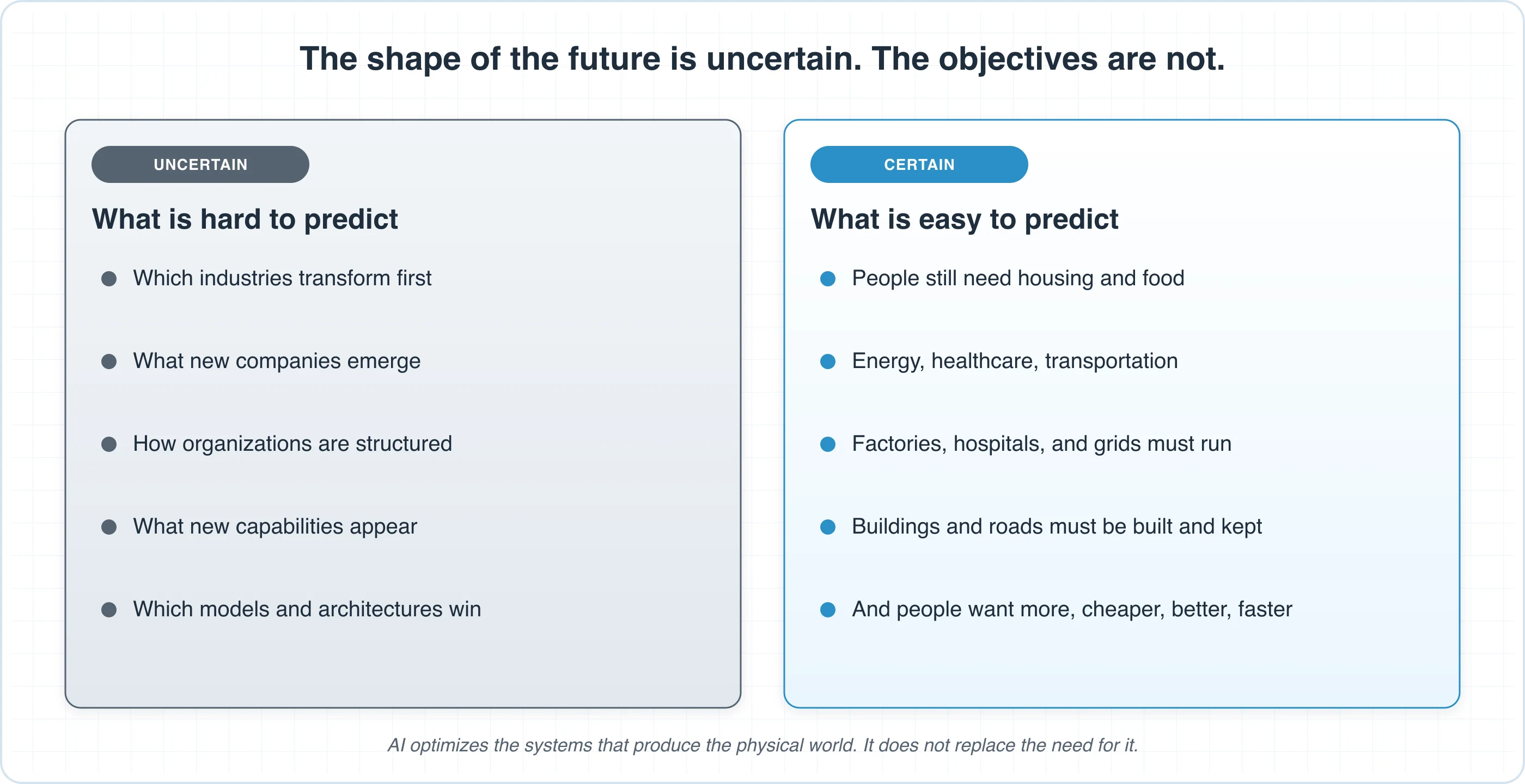
We also know that people will want more of these things at lower cost and higher quality, delivered faster and more reliably. The United States alone is short several million housing units by most estimates. Data centers, grid upgrades, and reshored manufacturing are adding demand on top of that. The shape of the future is uncertain, but these underlying objectives are as close to fixed as anything in economics.
That is why the trades sit in an unusually strong position. Every one of those objectives runs through a contractor. The demand for what you build is not going anywhere. What changes is the cost of the thinking that surrounds the building.
What this means for a contractor today
For a contractor, cheap intelligence means the office side of the business is about to become abundant while the field stays scarce, and the first move is to stop rationing the side that just got cheap.
Consider a mechanical contractor bidding twenty jobs a quarter with a three-person estimating team. Cheap intelligence lets that same team read every addendum, cross-check every quantity, and review every subcontract clause on every bid. The habit of triaging which documents get read carefully and which get skimmed was a response to scarce attention. When reading is nearly free, the triage is a liability, because the clause nobody read is the one that comes back as a change order.
That first move is the one Pelles Core is built for. It reads the whole bid set, addenda and revisions included, so the question of which sheets deserve a careful look stops being a question.
Reading everything does not tell the firm whether it should be bidding those twenty jobs at all. The margin actually earned on the ones it wins, and the places where the estimate falls apart once the job starts, matter more than the bid count. The number that goes out the door is never just a number. It is a bet on an objective, and that objective has to live on the jobsite: margin on completed work, schedule variance, rework hours. "AI adoption" is not an objective; it is an input. Saying precisely what the objective is, in terms a system can be held to, is the harder half of the problem and the subject of the next post in this series.
For survey data on where trade contractors actually sit on this curve today, our State of AI in the Trades report is free to download.
The slab still has to be poured
For two centuries, the scarce thing in a construction business was skilled attention: the estimator who could read a spec, the superintendent who could see a sequence problem before it happened. That scarcity is ending on the cognitive side. What stays scarce is everything on the other side of the curve, the concrete, the copper, the crews, and the calendar. The physical world sets the pace, and cheap intelligence is only worth what it changes on the jobsite.
The mills that won knew what to weave, for whom, and how to tell if it sold. Cheap intelligence gives every contractor the same loom. What separates them is what gets built with it, and whether anyone measured the result.
If you want to see how that plays out on a real bid set, get started with Pelles Core. It reads your documents as they are, and the conversation about what to optimize for is sharper once the reading is free.
Frequently asked questions
What does it mean that the cost of intelligence is approaching zero?
It means the marginal cost of producing one more unit of cognitive work (an analysis, a plan, a piece of software, a decision) is collapsing, the way the marginal cost of a manufactured good collapsed during the Industrial Revolution. Not literally zero and not all at once, but the price of a fixed level of AI capability has been falling by roughly an order of magnitude a year. When execution is that cheap, it stops being the constraint on what an organization can do, and the constraint moves somewhere else.
How is AI similar to the Industrial Revolution?
The Industrial Revolution gave people machines that could produce, move, and manipulate physical goods at a scale no individual could match, and the cost of physical output fell for generations. AI is beginning to do the same for reasoning, analysis, planning, software, communication, and coordination. The parallel matters because it tells you where the value moves. Once production is abundant, advantage shifts to the people who decide what to produce, for whom, and how to measure whether it worked.
Will AI replace the physical work of construction?
No. People will still need housing, energy, healthcare, transportation, and manufactured goods, and all of it has to be built, installed, and maintained in the physical world. What AI changes is the cognitive layer around that work, meaning estimating, scheduling, procurement, document review, coordination, and decision-making. Robots will eventually take on some physical tasks, but the near-term shift is that the office side of construction becomes cheap and abundant while the field remains the thing everyone is trying to serve.
Why doesn't construction get cheaper at the same rate as AI?
Because the expensive inputs are physical. Steel, copper, concrete, equipment, and skilled field labor do not fall in price by an order of magnitude a year the way AI inference has, and a 10x cost reduction in a physical input is a generational event. AI lowers the cost of the thinking around a project, such as estimating, review, and coordination, but the slab, the ductwork, and the crew hours still cost what they cost. That asymmetry is why demand for the trades holds while the office side changes fastest.
What should a contractor do about cheaper AI?
Start by ending the rationing. Estimating and project teams triage which documents get a careful read because attention used to be scarce, and that triage is where missed scope and bad clauses come from. When reading is nearly free, every addendum and every subcontract clause can be reviewed on every bid. Then point the new capacity at outcomes that live on the jobsite, such as margin on completed work, schedule variance, and rework hours, rather than at AI adoption, which is an input and not an objective.