Good Things Take Time
 Ido Glanz5 min
Move 37

In March 2016, an AI system called AlphaGo (developed by DeepMind) competed against Lee Sedol, among the world's finest Go players. Go is an ancient strategy game significantly more intricate than chess. Players alternate placing stones on a 19×19 board, attempting to control territory. The possible move combinations far exceed chess due to the game's complexity.
AlphaGo was performing adequately but encountered difficulties when it made Move 37 in the second match. This action was distinctive. It deliberated for ten to fifteen minutes, considerably longer than its typical response time. When the stone was finally placed, observers expressed confusion. The move appeared in merely 1 out of every 10,000 historical games.
Yet that extended consideration time yielded something remarkable. The move demonstrated brilliance, with Go specialists later acknowledging it as genuinely imaginative. It represented not merely optimal calculation, but the creative intuition previously believed exclusively human. This demonstrated altered perspectives on AI capabilities. "That extra time it took to think was what made the difference — it allowed the algorithm to explore, validate, re-think and finally derive an optimal solution."
The Quick Answer Problem
Standard AI interactions follow this pattern: you pose a question, the system responds within seconds through a single processing cycle. This resembles requesting directions without permitting time for map consultation—you receive their nearest approximation, though not necessarily the most efficient route.
This single-pass methodology contains inherent constraints. AI functions exclusively with immediately retrievable information, cannot confirm presumptions, and cannot investigate alternate approaches. For straightforward inquiries, this suffices. However, for complicated, high-stakes questions where solutions reside within thousands of documents, speed proves less valuable than precision.
What Makes AI Take Longer (and Why That's Good)
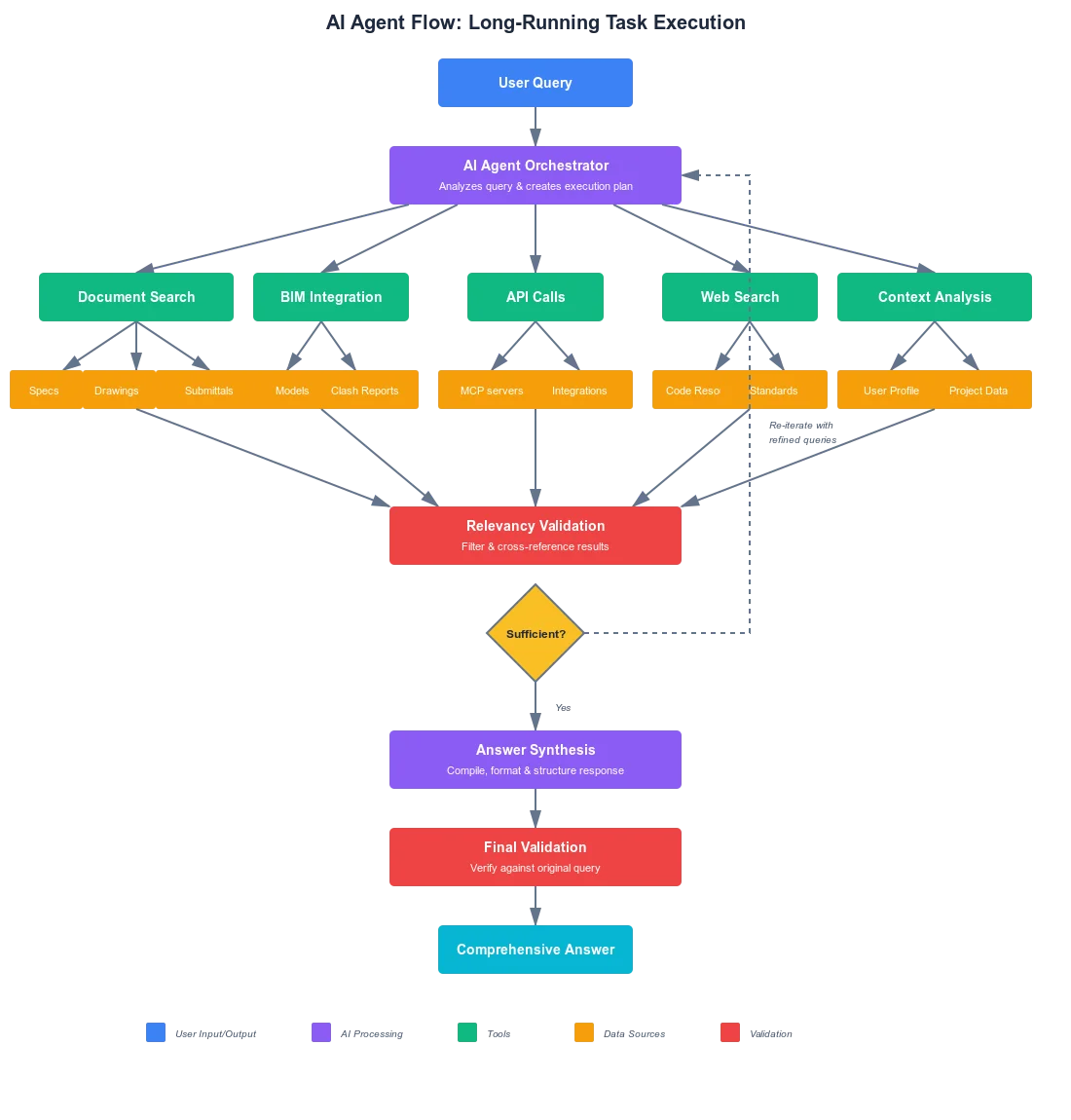
When AI dedicates additional processing time, it pursues accuracy more thoroughly. Multiple strategies exist, though primary approaches typically encompass:
-
Multiple data retrieval passes. Rather than depending on initial findings, AI obtains pertinent material repeatedly, enhancing searches based on preceding discoveries. It accesses document archives, technical specifications, prior project records, and compliance regulations, cross-validating all components.
-
Relevancy validation. AI determines whether each component actually addresses your question. Is this specification from the current edition? Does this information pertain to your specific building location? Is this the appropriate trade's responsibility?
-
Context interpretation. Sustained operations examine your identity, active project, and actual meaning versus literal phrasing. "What's the fire rating on the third floor?" carries distinct implications for structural engineers versus finishing specialists.
-
Answer validation and refinement. AI contrasts its preliminary response against your original inquiry, identifies inconsistencies, and reformulates for intelligibility. The distinction exists between "the fire rating is Type II" and "the third-floor corridor walls require 1-hour fire-rated assemblies per Detail 7.3 on Sheet A-401, using 5/8" Type X gypsum board over 3–5/8" metal studs."
-
Tool usage and integrations. Sophisticated AI engages with numerous platforms, gathering information from project administration systems, investigating specification repositories, consulting BIM models, and acquiring current regulatory specifications from online sources. Every engagement requires duration but substantially increases precision.
Working in the Background

These extended operations don't demand watching a progress indicator. They execute in the background while you concentrate on meaningful activities—value optimization, supervision meetings, resolution of field complications, and comparable responsibilities.
Envision assigning someone to investigate an intricate question. You don't supervise constantly. You authorize them to research documents and synthesize conclusions. AI operates equivalently, except it examines thousands of documents in the duration required for a person to process one.
Automatic Triggers: Answers Before You Need Them
Imagine something better: establishing programmed activations. Upon receiving a new submittal package, AI can start examining it immediately against specification standards. Upon incoming RFIs, AI commences investigating comparable instances and applicable contract language. At the moment you start your review session, thorough investigation is concluded and conclusions await you instead of requiring your anticipation.
Seeing the Plan First
One legitimate apprehension concerning extended AI operations involves lack of awareness. What happens if it investigates incorrect directions?
The mechanism: employ applications permitting strategy evaluation beforehand. Such applications utilize AI to plan comprehensively initially, revealing intentions and methodology: "I'll investigate these document collections, align these specifications, authenticate against these regulations, and organize results accordingly."
More sophisticated applications permit specialist participation throughout processing, letting you alter and enhance procedures while AI manages strenuous work, executing your mutual methodology.
The Construction Connection
This demonstrates critical significance in construction. Specification packages aren't blog articles—they represent exhaustive technical assemblies spanning thousands of documents. A standard commercial venture incorporates numerous drawings, specification documentation resembling substantial directories, and innumerable submittals, variation orders, requests for data, and session documentation.
The information embedded in these archives proves mission-critical. Inaccurate fire classifications, overlooked structural details, or disregarded regulatory restrictions can generate rework, schedule setbacks, inspection disappointments, or protection jeopardies. These aren't inconsequential matters where approximation functions.
Rapid AI responses cannot navigate that magnitude with demanded comprehensiveness. However, AI committing appropriate consideration—executing multiple investigations, confirming applicability, integrating specification information, and confirming conclusions—recognizes those concealed specifics with accuracy exceeding human capability across comparable timeframes.
The Trade-off Worth Making
Sedol subsequently stated that Move 37 exhibited something remarkable—"a move no human had thought of in thousands of years of playing Go." It demanded AlphaGo's capability to contemplate and investigate thoroughly to accomplish it.
Your construction inquiries merit equivalent rigor. When responses lie concealed throughout thousands of documents and circumstances demand precision, velocity becomes secondary to dependability. Extended AI investigations deliver both: comprehensive investigation alongside velocity exclusively machines accomplish.
Future instances when AI requires processing duration should evoke consideration of Move 37. Occasionally, anticipation represents not a shortcoming, but transformation.