Generative AI in Construction: 10 Real Use Cases (2026)
 Pelles.ai8 min
Every bid drops a mountain of information. Over 600 pages of specifications, 300+ drawing sheets, and additional addenda that arrive at inconvenient hours. The sheer volume of documents forces teams to skim over them, hoping nothing crucial is missed.
Key takeaways
- Generative AI in construction reads project documents (drawings, specs, addenda) and produces project-ready outputs like RFIs, submittal logs, and proposal sections — with exact source citations.
- Unlike search, which returns a list of links, GenAI returns finished deliverables you can edit and submit.
- 10 highest-impact use cases for trade contractors: spec review, drawing/spec/addendum compare, automated RFI drafting, proposal generation, submittal log creation, preconstruction checklists, value engineering support, lessons-learned retrieval, compliance snippet generation, schedule drafting.
- Best fit: MEP trades and other subcontractors processing high-volume bid packages.
- Where it falls short: tasks requiring physical site presence, real-time field judgment, or legal sign-off.
According to recent research, 77% of organizations have adopted AI to accelerate workflows, and preconstruction teams are benefitting from generative AI use cases to prevent bidding blind. Instead of "searching" documents, GenAI reads them and produces working outputs, such as RFIs and requirements lists. For MEP trades and other subcontractors, the payoff is straightforward: faster reviews, fewer misses, cleaner scopes, and more bids processed with the same headcount.
What is Generative AI, and How Does it Work?
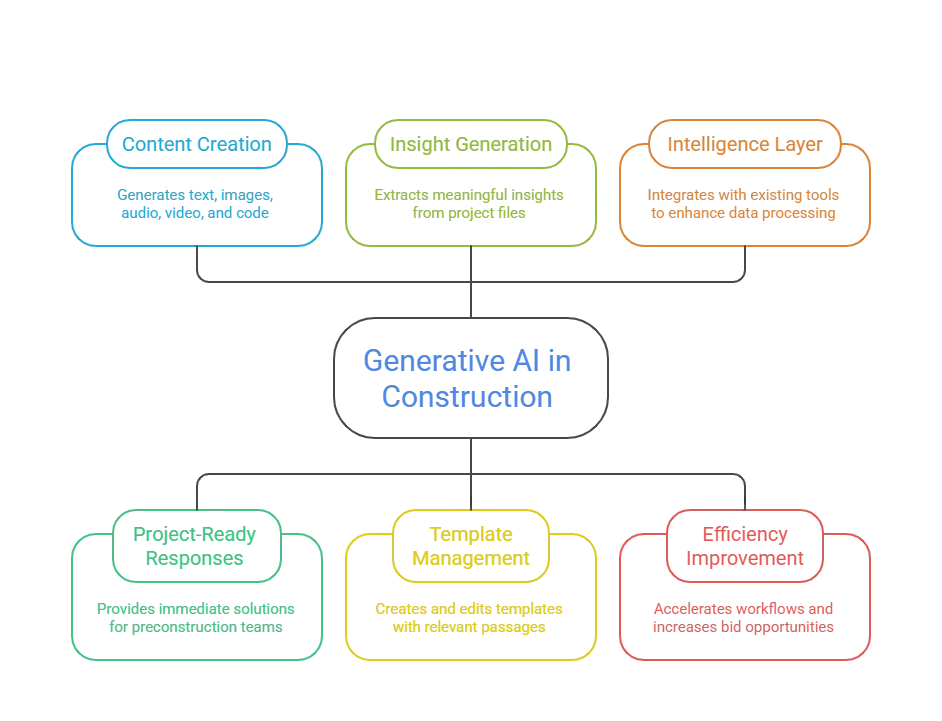
Generative AI learns from large datasets to produce content, such as text, images, audio, video, and code, and generates outputs. Whereas search engines provide a list of links, GenAI produces project-ready responses for preconstruction teams and can handle complex requirements, including spec-specific submittal cover sheets or a comparison note between drawing revisions.
Trade contractors use search to find info, but GenAI generates insights from all your files. It writes and edits templates for submittal logs, pulling the most relevant passages. After drafting, it cites exact sections used, saving you from scrolling through hundreds of pages.
You likely already use construction document management tools, but some GenAI technology sits as an intelligence layer on top of these platforms. Intelligence layers turn unstructured project data into actions and finished deliverables, so estimators and precon leads move faster, and you can make more bids. When drafts are ready for review with precise citations for quick verification, your team can bid with confidence.
How Generative AI is Positively Impacting Construction
Generative AI provides you with the information you need at speed. Unlike general chatbots, such as ChatGPT and Gemini, an intelligence layer sits on top of your files. Instead of skimming a 750-page spec set, it pulls the right clauses and auto drafts proposal sections and bid emails in your format, complete with references you can verify. Hours of document review are condensed down to a few minutes of editing; no more sitting in front of three monitors trying to digest it all.
But harnessing AI efficiency doesn't mean sacrificing the quality of your work. GenAI improves accuracy and reduces core construction industry risk factors by comparing docs and flagging contradictions, even something as small as an amended equipment model. The result is a tighter scope and reduced risk of costly mistakes.
This additional AI support means more capacity without extra hiring. With proposals and RFI drafts produced for you, estimators can focus on pricing and strategy instead of sifting through documents.
All the use cases discussed have a shared goal: to drive consistency. Templates and style guides ensure that proposals and emails align with your voice, commercial terms, and inclusions and exclusions, maintaining consistency across the entire team, so every submission appears polished and aligned with your brand.
10 Generative AI Use Cases in Construction
In this section, we're highlighting practical GenAI use cases built into the document intelligence platforms that sit on top of your existing document management tools. Embedding AI into the tools where your drawings and specifications reside yields faster handoffs and project-ready outputs that your team can actually use.
1. Spec Review
AI has the capability to scan multi-hundred-page spec pages and flag trade-specific requirements, such as warranties and testing, then point you to the exact page and paragraph. Instead of skimming hundreds of pages, your team jumps straight to the clauses that matter for your scope.
If we look at a real world example, Pelles' document intelligence platform features a tool called DoubleCheck that instantly surfaces these spec clauses. DoubleCheck links back to the exact paragraph, so your estimators can cite the contract accurately.
2. Drawing, Spec, and Addendum Compare
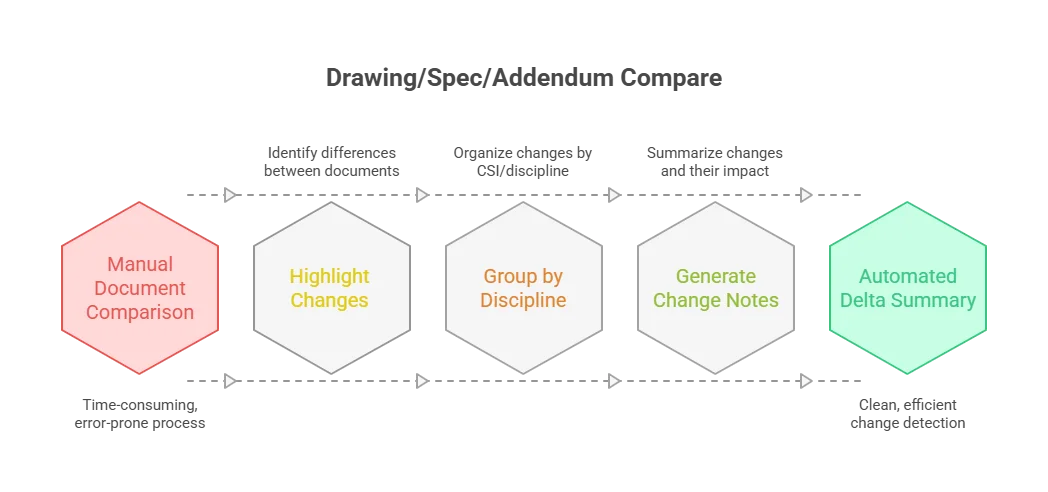
When a new set is released, generative AI can compare prior drawings, specifications, and addenda against the latest files and highlight what has changed, including breaker sizes, insulation ratings, equipment tags, panel schedules, and even notes. For MEP trades, it can also flag feeders and conduit sizes, MCC panel changes, and any VFD notes that shift across revisions. Rather than manually flipping between PDFs, you get a clean summary of deltas with page and sheet references.
The payoff in preconstruction is catching scope movement early and pricing it correctly. This foresight reduces the risk of missed requirements and protects margin by keeping clarifications and proposals aligned with the latest contractual documents.
You could prompt GenAI in various valuable ways, like requesting highlighted changes grouped by CSI/discipline with side-by-side citations and brief change notes describing what shifted and likely cost and time impacts. With this use case, estimators can route quick follow ups to vendors and generate clarifications without having to start from scratch.
3. Automated RFI Drafting
Generative AI turns RFI drafting from a chore into a guided, streamlined workflow. Once your team learns how to use AI effectively for construction workflows, you'll move faster with fewer misses and more consistent outputs. It can pinpoint conflicting specs or missing details, cite the exact sheet, and assemble a clear question with proposed resolution options. With this visibility, you'd be able to send an RFI that references the contract documents and suggests a practical path forward.
For operations and preconstruction teams under deadline pressure, the impact is faster, higher-quality RFIs that protect scope and schedule. You can surface issues early, reduce back-and-forth, and lower the risk of carrying the wrong assumptions into your proposal.
4. Proposal Generation and Scope Language
Another use case for GenAI is assembling project-specific proposals that read as if your best estimator wrote them on a calm Friday. It can map spec requirements to your trade scope and draft clean inclusions and exclusions, alternates, and schedule notes. The result is consistent, professional proposals produced in hours, not days, even when timelines are tight.
Preconstruction teams get the upside of faster turnarounds, and your commercial terms appear the same way every time. Spend time validating and pricing instead of retyping the same paragraphs or hunting for previous "winning" language.
5. Submittal Log Creation
Submittals are owned by PMs during operations. GenAI can front-load work by reviewing spec divisions to extracting every submittal requirement (manufacturers, details, etc). Then, it assembles a clean, trackable log tied to the exact spec paragraphs. PMs take control earlier (validating, adding status and dates, exporting to the project management system), so the team starts day one with a contract-accurate log instead of spending days building a spreadsheet from scratch.
6. Precon Checklists
What used to require multiple reads and sticky notes becomes a concise, auditable list with the help of AI. An intelligence layer can consolidate preconstruction requirements like coordination notes and phasing constraints that are usually scattered across divisions and addenda. This automation puts them into a single, project-specific checklist, helping you set expectations and plan labor accordingly.

7. Value Engineering and Alternate Pricing Support
Value engineering at a later stage doesn't have to blow up your schedule, as GenAI can review the spec and drawings and pull feasible alternatives. It can summarize pros and cons and compliance gaps, and even draft a cover letter with clear assumptions. You can help estimators price the right alternates the first time and avoid miscommunication over missing data.
8. Lessons Learned and Vendor Intelligence
In-house knowledge is often siloed or walks out the door when colleagues retire. With GenAI built into an intelligence layer, you can capture this information and turn past RFIs, proposals, vendor scorecards, and cost notes into a searchable knowledge base. When a spec calls for a tricky test or a challenging manufacturer, you can make smarter decisions and deliver more consistent proposals.
9. Safety and Compliance Snippet Generation
Compliance language varies by owner and general contractor, and specs reference different standards and codes. Success with GenAI means understanding how it can generate site- and owner-specific safety, QA/QC, and compliance sections that cite the exact standards named in the documents, aligning your submission with contractual requirements on the first pass.
10. Schedule Drafts and Forecasting
Early schedules are slow to build from scratch. Generative Workflows assemble the initial sequence and dependencies from your files (and every duration/constraint is cited to contract language), so weekly forecasting starts on solid ground.
You can let the intelligence layer pull milestones, sequencing constraints, submittal and approval durations, and long-lead indicators from the specs to draft a realistic starter schedule. This capability accelerates coordination with the GC and other trades, exposing risks sooner before they become costly.
Bid More Successfully With an Intelligence Layer
Generative AI is already reshaping preconstruction and operations as a lever for margin and growth, and adopting this technology offers speed and consistency payoffs. Teams that embed an intelligence layer into preconstruction move bids and projects from "best effort" to repeatable, reliable outputs, gaining the confidence to bid more decisively.
Pelles brings this capability to the trades with an intelligence layer designed for MEP subcontractors. Pelles' GenAI can generate proposals, RFIs, and submittal logs in your format, allowing your team to handle more with greater confidence. In addition to AI, Pelles' DoubleCheck feature surfaces requirements before they become costly misses, and Compare flags deltas the day addenda drop.
MEP leaders use Pelles to scale without adding headcount while improving consistency across every submission, so you can pursue more right-fit opportunities and win them with confidence.
Frequently asked questions
What is generative AI in construction?
Generative AI in construction is an intelligence layer that sits on top of your project documents. Unlike search, it reads drawings, specs, and addenda to produce project-ready outputs like RFIs, submittal logs, and proposal sections with exact citations.
How does generative AI help trade contractors?
GenAI helps trade contractors review documents faster, reduce risk by flagging contradictions, and increase bid capacity without adding headcount. It automates spec review, RFI drafting, submittal log creation, and proposal generation.
What are the top generative AI use cases in preconstruction?
The top use cases include spec review, drawing and addendum compare, automated RFI drafting, proposal generation, submittal log creation, preconstruction checklists, value engineering support, lessons learned retrieval, compliance snippet generation, and schedule drafting.
What are the best AI use cases for construction in 2026?
In 2026, the highest-impact AI use cases for construction are spec review and requirement extraction, drawing and addendum comparison, automated RFI drafting, proposal generation, and submittal log creation. These use cases sit inside document intelligence platforms that read your actual project files and produce cited, project-ready outputs.
How do trade contractors use generative AI day-to-day?
Trade contractors use generative AI to extract spec requirements during bid review, generate RFI drafts when contradictions are found, populate submittal logs with spec citations, compare drawing revisions for scope changes, and draft proposal sections from prior bid language. The common thread is converting unstructured project documents into structured, project-ready outputs.
What is generative AI good at in construction — and what should it not be used for?
Generative AI is strongest at document-heavy work: spec review, RFI and submittal drafting, drawing comparisons, and proposal generation with citations. It should not be used for tasks requiring physical site presence, real-time field judgment, signed code interpretations, or anything where a missed citation creates legal exposure. Use it to draft and accelerate — always with human review before submission.
How is generative AI different from ChatGPT or general AI chatbots in construction?
General chatbots like ChatGPT and Gemini answer from their training data — they don't have access to your project files. A construction-specific intelligence layer sits on top of your actual drawings, specs, and addenda and produces outputs cited from your real project documents. The difference is the citations: a general chatbot can only guess; an intelligence layer can show the page and paragraph it pulled from.