In our previous article, we introduced the “Iron Man Suit” principle: successful AI tools don’t replace us, they augment us. Tony Stark wasn’t replaced by his suit; he became exponentially more capable with it. The suit provided superhuman strength, flight, and data processing, but Stark’s ingenuity, intuition, and strategic mind remained firmly in the pilot’s seat. This model is built on two pillars: a tight feedback cycle where AI generates and the human verifies, and an autonomy slider that lets the user control how much the AI contributes. This is the foundation for building practical, human-centric AI.
But this reactive, command-driven approach only scratches the surface of AI’s true potential. The greatest advantage of modern AI is its capacity to work tirelessly in the background, processing vast amounts of information while we focus elsewhere. This capability allows the suit to evolve from a reactive tool into something far more integrated: an Ambient AI Agent. This is not just a tool you command, but a digital teammate that manages complex workflows and collaborates with you as a persistent partner.
The question, then, is how do we build this proactive, ever-learning agent? How do we achieve this vision without falling into the trap of creating unreliable, “black box” systems that ultimately fail us?
The answer is surprisingly straightforward: You build the Ambient AI Agent by rigorously applying the Iron Man Suit principle. The path to a trusted digital teammate isn’t a reckless leap into full autonomy. It is a deliberate, step-by-step process of building a smarter, more perceptive suit. In this article, we’ll explore how.
From Reactive Tool to Proactive Partner
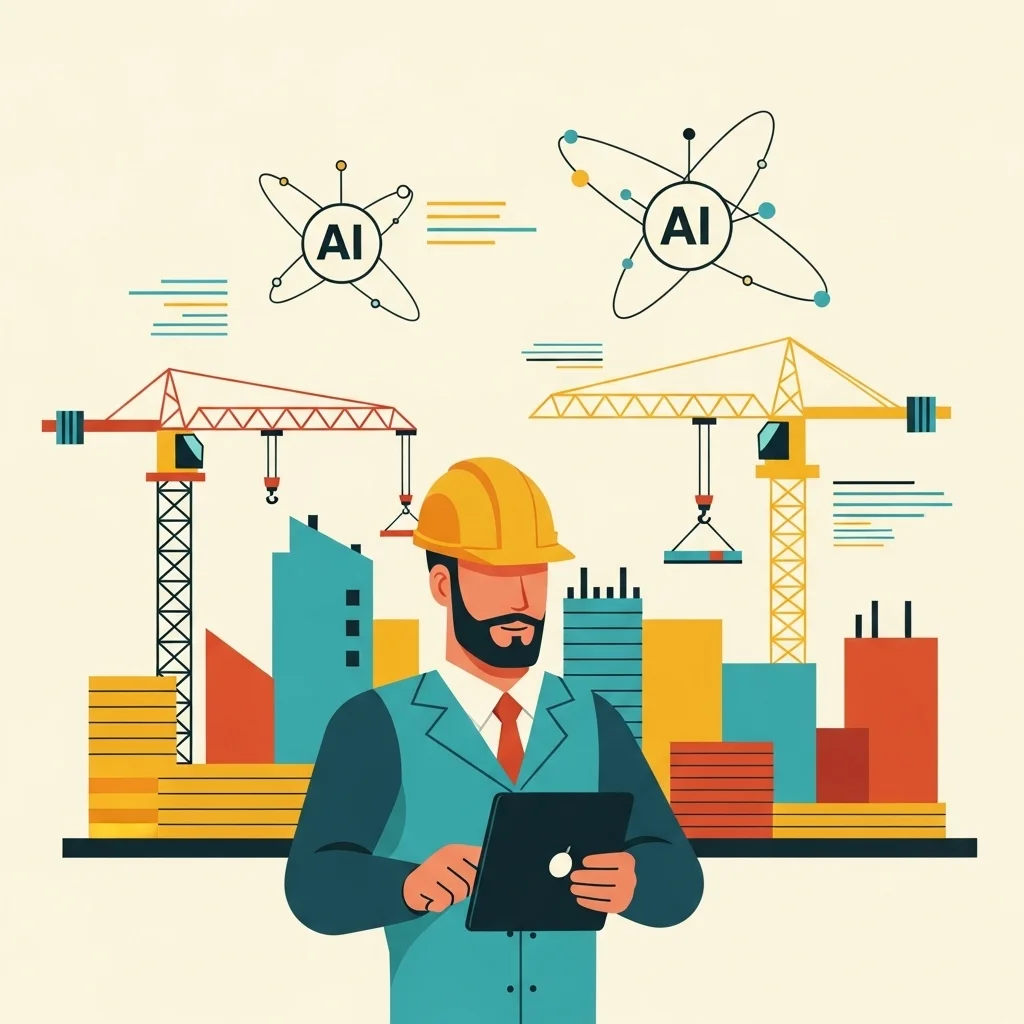
The primary limitation of the classic “Iron Man Suit” is its reactive nature. Like any tool, it’s incredibly powerful when you pick it up, but it sits idle until you do. The user must recognize a need, open the application, feed it data, and initiate a command. The human is always the starting pistol for any AI-assisted task. This creates an invisible ceiling on productivity; the AI’s potential is shackled to the user’s moment-to-moment awareness and initiative.
The Ambient AI Agent shatters this ceiling by fundamentally changing the interaction model. Can be described as an AI that “never sleeps,” this agent is not a tool you open, but a persistent presence that works alongside you. It is “always on” and, crucially, event-driven. Instead of waiting for a command, it is triggered by events in your digital environment — a new email, a calendar invite, a change in a project management board, or an update in a CRM.
To illustrate this evolution, let’s consider a common task for a project manager: handling a Request for Information (RFI).
- The “Digital Toolkit” (Reactive) Approach: A project manager, Jane, sees a new email in her inbox. It’s an RFI from the plumbing subcontractor about a pipe specification. She opens her project management software and decides to use its AI chat assistant to speed up the process. She copies the question from the email, pastes it into the chat, and attaches the PDF. The AI helps populate the new RFI form, but Jane still has to review it, look up the correct architect, and manually assign it. Although the AI assistant helped with data entry, the entire process of identifying, logging, and routing the RFI was initiated and directed by Jane.
- The Ambient AI Agent (Proactive) Approach: Jane’s digital teammate is always monitoring her inbox. It detects the new email from the subcontractor, recognizes it as an RFI based on the sender and keywords, and autonomously begins processing it. It parses the email content and the attached PDF, logs it in the project management system with the correct RFI number, and identifies from the document’s context that the question must be routed to the lead mechanical engineer. It then sends Jane a notification: “New RFI from AquaPlumb logged regarding pipe specs in Area B. I’ve assigned it to the mechanical engineer with a 3-day response deadline. Ready for your review.”
In the second scenario, the AI has transformed from a passive calculator into a proactive junior partner. It didn’t just augment Jane’s ability to do the task; it augmented her capacity by initiating the task for her, freeing her to focus immediately on the high-level strategic decision: Is this bid worth pursuing?
Redefining the “Autonomy Slider” and “Verification Loop”

This shift from a reactive tool to a proactive teammate requires us to rethink the core mechanics of the “Iron Man Suit.” The “Autonomy Slider” and “Generation-Verification Loop” don’t disappear; they evolve to govern a more complex, asynchronous relationship.
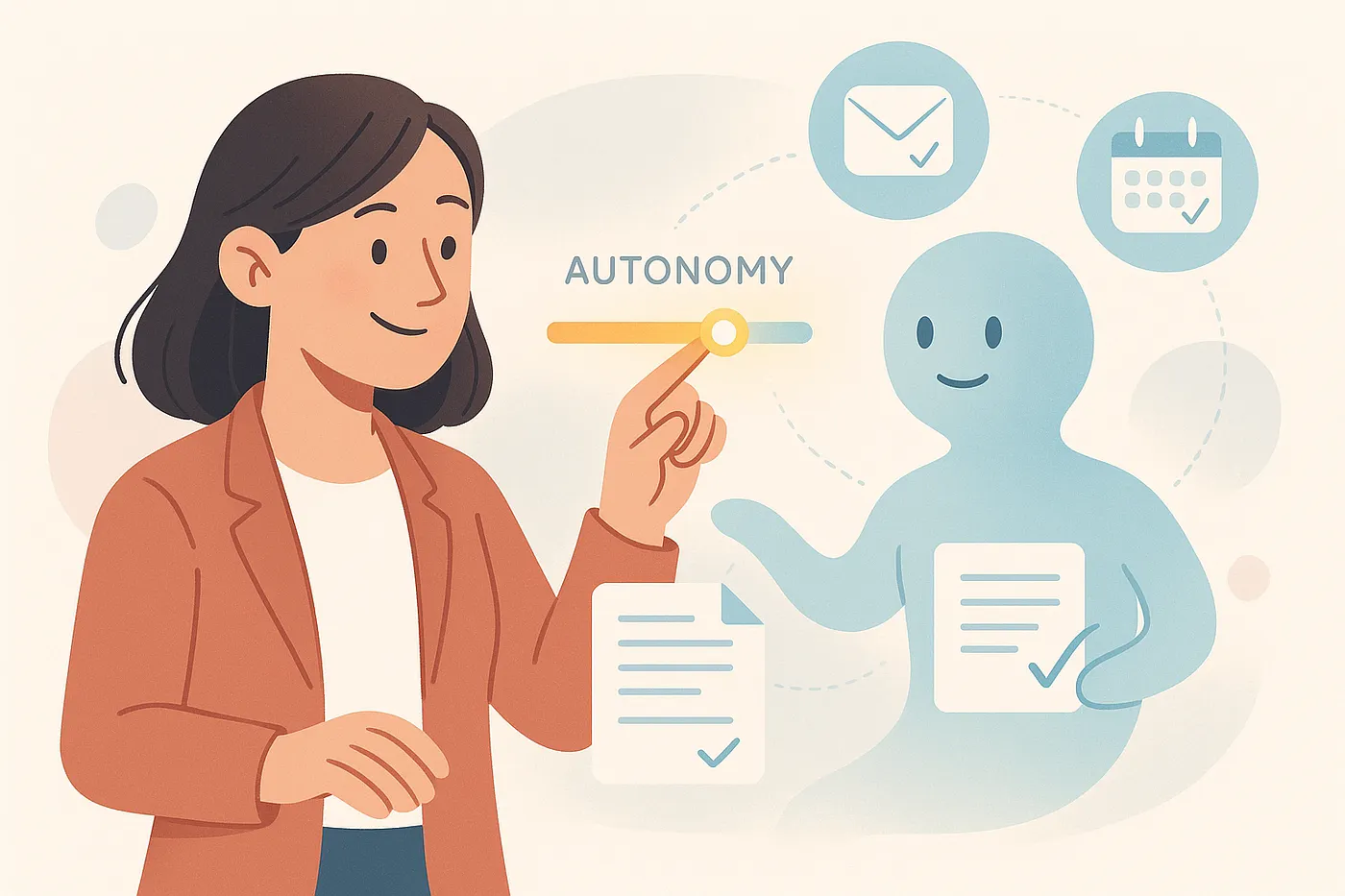
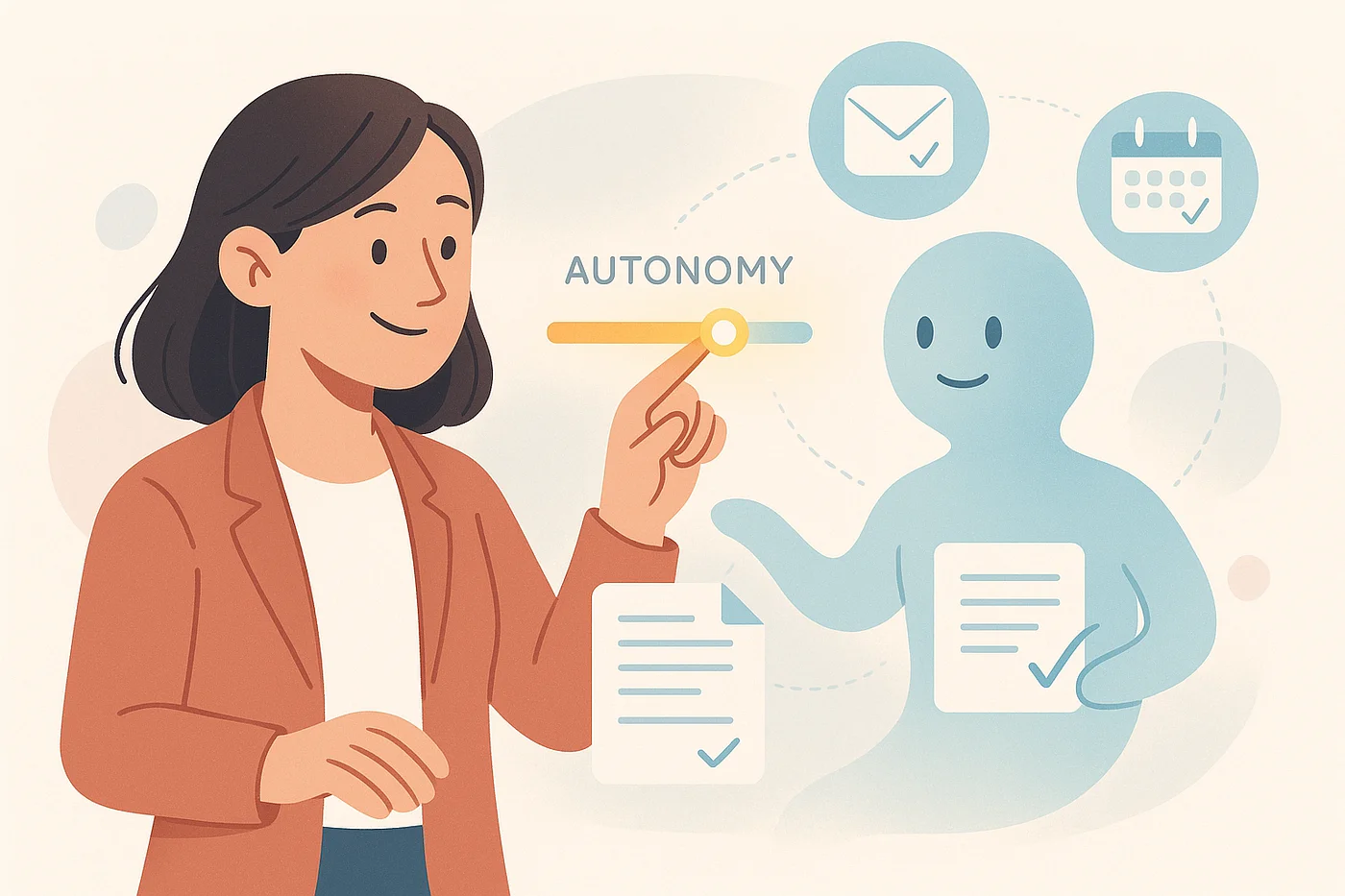
The “Autonomy Slider” transforms from a task-level control to a set of strategic “rules of engagement.” In the classic model, a user might slide autonomy up or down for a single report. In the ambient model, the user sets broader permissions and goals. For her super-estimator agent, Jane might configure the slider with rules like:
- Low Autonomy: “You may monitor all incoming emails and flag potential bids, but do not start an estimate without my explicit command.”
- Medium Autonomy: “You may automatically generate preliminary estimates for any bid under $500,000 from our existing client list. Present the draft to me for verification before any further action.”
- High Autonomy: “For any standard renewal bid from a top-tier client, you may generate the estimate, draft the proposal using our standard template, and schedule a 15-minute review meeting in my calendar.”
The slider is no longer about how to do a single task, but what the agent is permitted to do within the broader workflow. It’s a shift from micromanagement to strategic delegation.
Similarly, the “Generation-Verification Loop” becomes more asynchronous and milestone-driven. The tight, second-by-second loop of “generate-verify-generate” is ill-suited for an agent that works in the background. Instead, the loop stretches over hours or even days. The agent generates, refines, and cross-references data autonomously. The “verification” step then occurs at critical junctures when human judgment is essential.
The “morning briefing” is the perfect example of this new loop. The agent works overnight, sifting through communications, project updates, and data dashboards. In the morning, it presents a synthesized summary: “Here are the three most urgent emails, here is the status of Project X which is falling behind schedule, and here is the preliminary bid I drafted for you.” The human’s verification is not on every small calculation, but on the prioritized output and the strategic next steps. The loop is completed when the human provides feedback or direction, which in turn launches the agent’s next cycle of autonomous work.
Building Trust with Your New Digital Teammate
Granting an AI this level of proactive autonomy naturally raises critical challenges, primarily centered on trust. How can we rely on an agent working in the background without constant supervision? This is where concerns about data quality and the “black box” problem — not knowing why an AI made a certain decision — become paramount.
The solution lies in framing the agent not as an infallible oracle, but as an “ever-learning apprentice.” This approach is fundamental to building trust over time. You wouldn’t hire a new human employee and immediately give them the keys to your most sensitive accounts. You start them with low-risk tasks, observe their performance, provide feedback, and gradually grant more responsibility as they demonstrate competence.
The same principle applies to the digital teammate:
- Start Small: Initially, the ambient agent is tasked with low-risk, high-value activities. It might only be allowed to categorize incoming requests, summarize long documents, or flag action items from meeting transcripts.
- Learn from Feedback: Every time the human corrects the agent — re-categorizing a request, editing a summary, or ignoring a flagged item — it provides a crucial data point. This is the asynchronous “Verification Loop” in action, serving as a continuous training mechanism.
- Earn More Autonomy: As the agent’s accuracy and reliability improve, the user gains confidence. They might then adjust the “Autonomy Slider” to allow the agent to draft responses, perform preliminary analyses, or even manage calendar scheduling. The agent literally earns its autonomy by proving its value.
This model keeps the human firmly in the loop, reinforcing the core philosophy of the “Iron Man Suit”. The goal is not to create an autonomous entity that replaces human judgment, but to build a reliable partner that can be trusted to handle an increasing scope of work. Human oversight remains the ultimate backstop, ensuring that the AI’s powerful capabilities are always aligned with human goals and values.
Conclusion: The Future of Work is a Collaboration
The journey of workplace AI is a clear evolutionary path. We began by building an “Iron Man Suit” — a powerful, reactive tool that amplified our abilities on command. We mastered the principles of the “Generation-Verification Loop” and the “Autonomy Slider” to make these tools effective and safe. Then, that suit fuses with our digital environment, transforming into a proactive, persistent digital teammate.
This Ambient AI Agent represents the next frontier of productivity. It retains the foundational principles of human-machine collaboration — human oversight and adjustable autonomy — but applies them in a more sophisticated, asynchronous manner. By handling the constant churn of monitoring, filtering, and preliminary processing, these agents will liberate human workers from the tyranny of the urgent and the tedium of the repetitive.
The future of work is not a contest between humans and machines. It is a collaboration. It’s a future where every knowledge worker is supported by a dedicated digital teammate, one that prepares their day, anticipates their needs, and executes routine tasks flawlessly. This frees us, the human pilots, to focus on what we do best: strategic thinking, creative problem-solving, building relationships, and making the critical judgments that will always require a human mind at the helm. The suit is no longer just something we wear; it’s the partner we work with.
Thank you for reading. If you found this article helpful, please share it with your network and give it a clap! :)