The AI Dividend: Spend It on Margin, Not Bids
 9 min
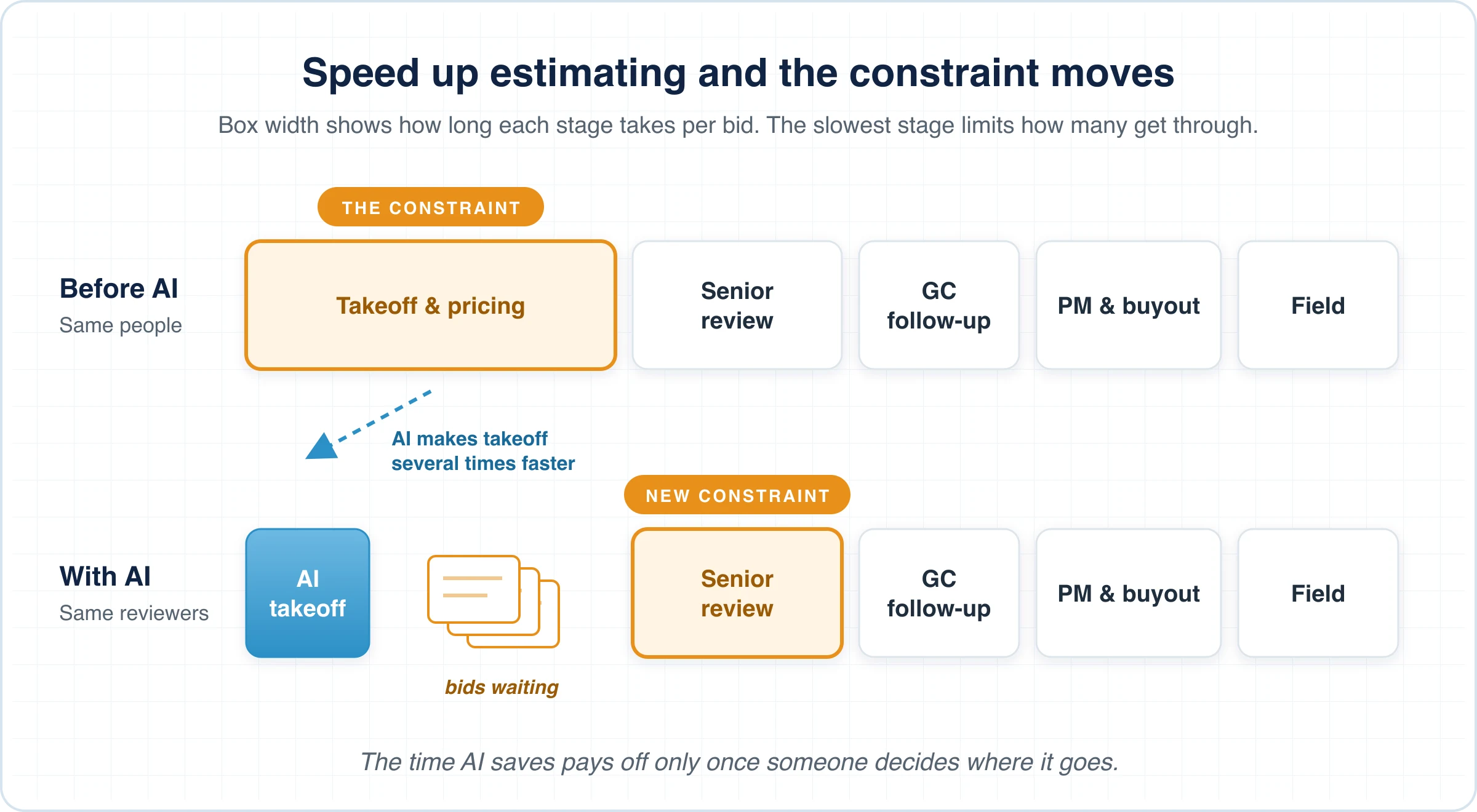
It's Thursday afternoon. Three bids are due Tuesday, and your chief estimator still has to go through all three: the takeoff, the labor units, the exclusions and clarifications letter. Now give the estimating team an AI that does first-pass takeoff in a third of the time. By the following Thursday there are nine bids on that desk, and the chief estimator's week is exactly as long as it was.
Anthropic's economics team found the same pattern in 66 interviews at 58 US companies for Working with AI, published November 23, 2026. When AI speeds up one task, the work piles up at the next one that still needs a person, often whoever reviews the AI's output. Where nobody planned for the hours AI freed, people spent them on work they enjoyed more, or simply worked less.
The short answer: every contractor will soon have the same models, so every firm will collect the same AI dividend, the hours AI frees up. In Anthropic's interviews, the most valuable AI uses came with changes to roles and processes. For a contractor, faster takeoff moves the bottleneck to senior review, and field labor caps backlog anyway. Spend the dividend on margin per job, through scope coverage, bid selection and customer time, rather than on more bids.
What Anthropic's study found
Across nearly 300 AI applications, most added value by raising output rather than cutting costs, AI slowed hiring far more often than it caused layoffs, and the highest-value uses required changes to processes or roles.
| Finding | What the interviews showed |
|---|---|
| Value | Most applications raised output, about half by speeding up existing work and half through better quality or new services |
| Jobs | Only two companies saw AI eliminate a position. Ten hired more because of AI, and two-thirds hired less, mostly by growing without adding staff |
| Bottlenecks | Reviewing AI output, functions that could not keep pace, uneven adoption, and missing data and infrastructure |
The 58 companies are Anthropic customers chosen for variety, and the value ratings are self-reported, so treat this as qualitative evidence. Construction is one of many industries in the study, so what follows is our translation of the findings for contractors.
Same AI, three outcomes
The report sorts what companies did into three approaches, and three law firms in the study show the range. The first automated its mailroom and put its clerks' jobs at risk. The second struggled to get people using AI well. The third redesigned roles and eliminated no jobs.
| Approach | At a contractor | How it breaks |
|---|---|---|
| Top-down automation | Buy a takeoff or submittal agent and roll it out to every estimator | Goes stale as models improve, and the experts it depends on resist it |
| Bottom-up experimentation | Give every seat a chat assistant and see what people build | Gains stay with whoever built the tool, and nobody plans to maintain it |
| Reorganization | Change roles, handoffs and data access around what AI frees up | Takes management attention, and needs revising as models change |
Top-down automation produced the clearest labor changes and the most fragile systems. Interviewees warned that vendor tools built for one industry go stale as models improve, a warning we answer at the end of this post. It also depends on the experts it automates. "If I'm open to this, I'm essentially building my own coffin," one employee said. Your chief estimator will write a good scope checklist for an AI only after you tell them what their job becomes once it works.
Bottom-up experimentation produced the best individual stories and the weakest company-wide results. Every contractor already has a bid summary spreadsheet full of macros that only one estimator understands. AI makes more of them, faster, and the gains stay with whoever built them.
Reorganization is what the third law firm did. Once AI wrote the first drafts associates used to write, the firm paired juniors with a senior attorney to mark up each draft, so they would still learn to tell "a good draft or a bad draft." Swap in a junior estimator and a first-pass takeoff, and you have a problem every contractor adopting AI estimating will meet within a year.
Every hour AI saves lands on someone's desk
When AI speeds up one stage of a job, the work piles up at the next stage that still depends on a person. At a contractor, that is the chief estimator first, then the PMs, the GC relationship and the field. "The closer you are to the money, the harder it is for models to excel in that job," one executive in the study said.
Take an illustrative mechanical contractor with four estimators, each with about ten days a month for takeoff and pricing, and a chief estimator with about eight days a month for review:
| Illustrative bid desk | Today | With AI takeoff |
|---|---|---|
| Estimator days per bid (takeoff and pricing) | 3 | 1 |
| Bids the estimators can produce per month | About 13 | About 40 |
| Chief estimator review per bid | 4 hours | 4 hours |
| Review hours available per month | 64 | 64 |
| Bids that can go out per month | About 13 | About 16 |
Takeoff got three times faster, and output rose by about a quarter. The chief estimator's calendar is now the firm's real capacity plan. Swap in your own numbers to see where yours sits.
Forcing more bids through that desk is the weakest use of the dividend. Your hit rate on the extra jobs is likely to be lower, and your crews cannot run three times the backlog. The hours pay more as margin on the jobs you already chase:
- Scope coverage. Check every Division 22, 23 or 26 section against the exclusions and clarifications letter.
- Bid selection. Spend the time on go/no-go, and stop pricing jobs you were never going to win.
- Labor units. Compare the estimate against job cost history from similar jobs.
- Turnover. Walk the PM through the assumptions that hold the number together, which is where good estimates usually fall apart.
Where the winners spend the dividend
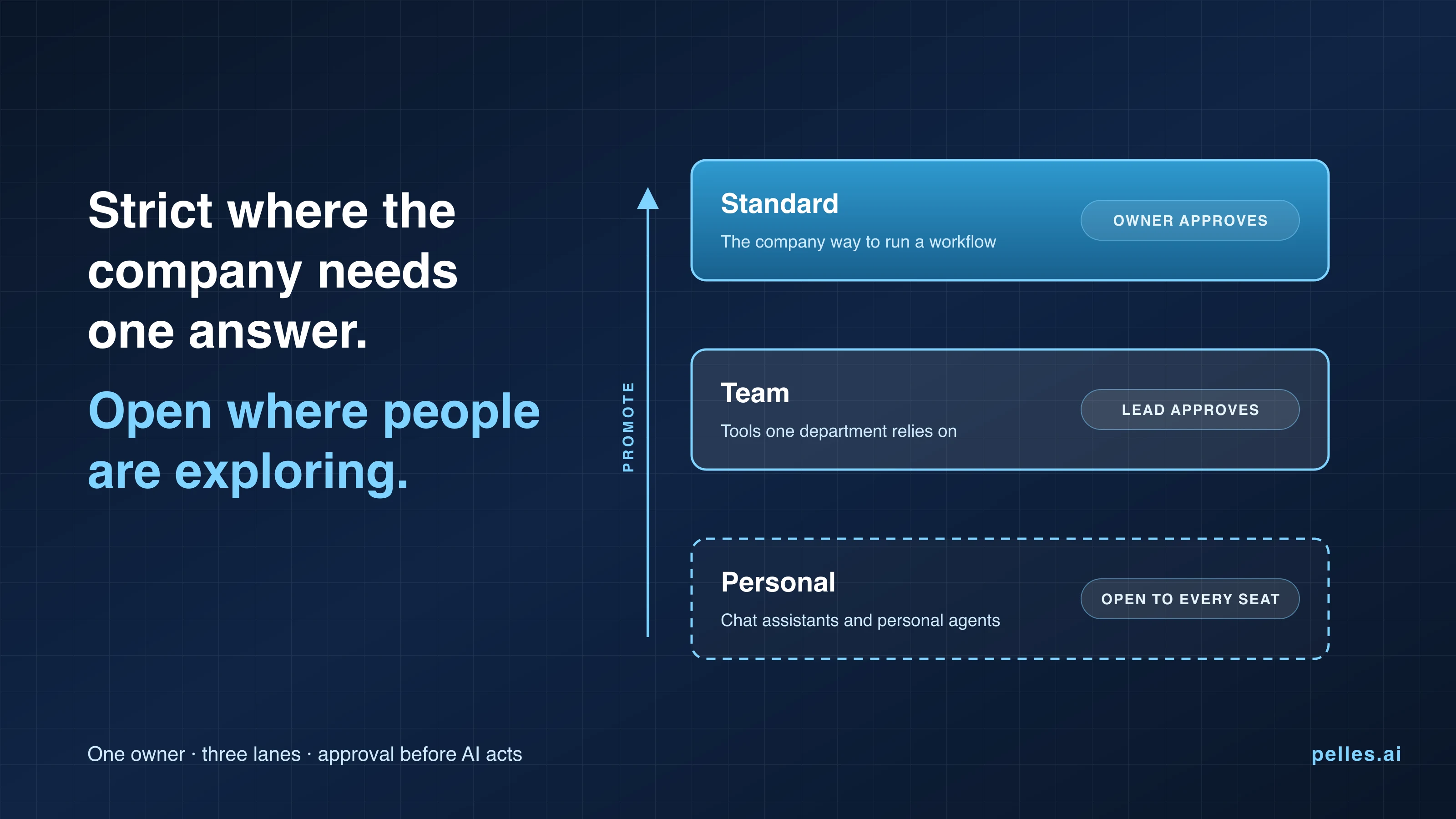
The report found three moves behind the highest-value uses: broader roles, people moved to the tasks AI cannot do yet, and shared data. Each translates directly to a contractor.
Broader roles. AI makes it easier for one person to own a whole workflow, and makes the "context loss" of each handoff more costly. A contractor's costliest handoff is from estimating to operations. With takeoff and quote leveling handled, the estimator can stay on the job through buyout and run the turnover meeting. The person who spans the chain stops being a lucky accident and becomes a job description.
People moved to the bottleneck. At one construction company in the study, an agent now collects the crews' updates and drafts the customer's daily report, and the PMs spend those mornings with customers. Planned role by role at a specialty contractor:
| Role | Work AI takes on | Where the time goes |
|---|---|---|
| Chief estimator | Reviewing every line of every bid | Reviewing what the agent flags, writing the scope checklist, go/no-go |
| Estimator | First-pass takeoff in Accubid or QuickPen, quote leveling | Scope review, the exclusions letter, staying on through buyout |
| Junior estimator | Manual takeoff as a training ground | Marking up AI takeoffs beside the chief estimator |
| Project engineer | Assembling submittal packages and logging RFIs | Checking packages against the spec and owning the exceptions |
| Project manager | Calling sites and writing the daily report | Time with the GC and the owner |
If manual takeoff was how juniors learned to spot a missing scope item, the junior estimator row is the one a trade with a labor gap cannot skip.
Shared data. A contractor's data sits across Accubid or Trimble, Procore or ACC, Bluebeam, Viewpoint Vista or Sage 300 CRE, and a shared drive. Much of it is rules waiting to be written down: over 90 days in our product, 55% of contractors' document questions belonged to question sets re-run project after project. Those checklists are your chief estimator's judgment in writing. With the data in one place, they run on every job and stay in the firm when people retire.
What the hiring numbers mean for contractors
The study saw few AI layoffs and slower hiring, with outsourced work cut first. About a third of the hiring declines came from not backfilling people who left, so if your senior estimators retire without replacement, written checklists are how their judgment stays. And if you send takeoff or BIM detailing to an outside service, expect that modular work to change first. The next contract should pay for review and exception handling, or the work should come back in-house.
The AI-native contractor, five years out
Follow the pattern forward, and this is the firm we expect to pull ahead. It runs the same field crews with a smaller office per dollar of revenue, because agents handle takeoff, document control, daily reports and first drafts. Its people are organized around judgment:
- Estimators write the rules agents check bids against and decide which jobs to chase.
- Project leads own a job from bid review to closeout.
- Coordinators run the agents and keep them current as models change.
- Juniors learn by marking up agent output beside a senior.
- One data layer answers anyone's question about any job.
Its org chart gets revised every quarter, because the bottleneck keeps moving as models improve. The economic historian Paul David, whom the report cites, described factories that swapped a steam engine for an electric motor and saw little gain until plants were rebuilt around the new power, decades later. The gap between contractors that rebuild around AI and those that bolt it on will widen the same way.
A one-week bottleneck audit
You can find out where your AI dividend will land in a week, before you buy anything:
- Pick one workflow end to end, such as bid review through buyout.
- List each stage, who does it, and its hours per job today and with AI.
- Find the new slowest stage. That desk is your capacity plan.
- Write down where the freed hours go for each role.
- Tell your experts the deal before you ask them to build anything.
Run it again every quarter.
The models are the same for everyone
The report's authors are careful to say none of this is a guarantee against AI-driven job loss, but they conclude that the variation they saw "suggests they have some say in how AI changes work." For a contractor, that say comes down to roles, handoffs and data.
As for the report's warning about industry vendors, we built Pelles so the parts that should last belong to you. Its agents work on your own drawings, specs and contracts, your checklists stay yours, and your people can build apps on top under rules you set. The models underneath will keep improving, and your firm's written-down judgment keeps running on them.
Send us last quarter's bid log: bids submitted, hit rate, and your chief estimator's review hours. In an hour we will map with you where the AI dividend would land and which desk becomes the constraint. Every contractor will collect the same dividend. Where it goes is yours to decide.
Frequently asked questions
What is the AI dividend?
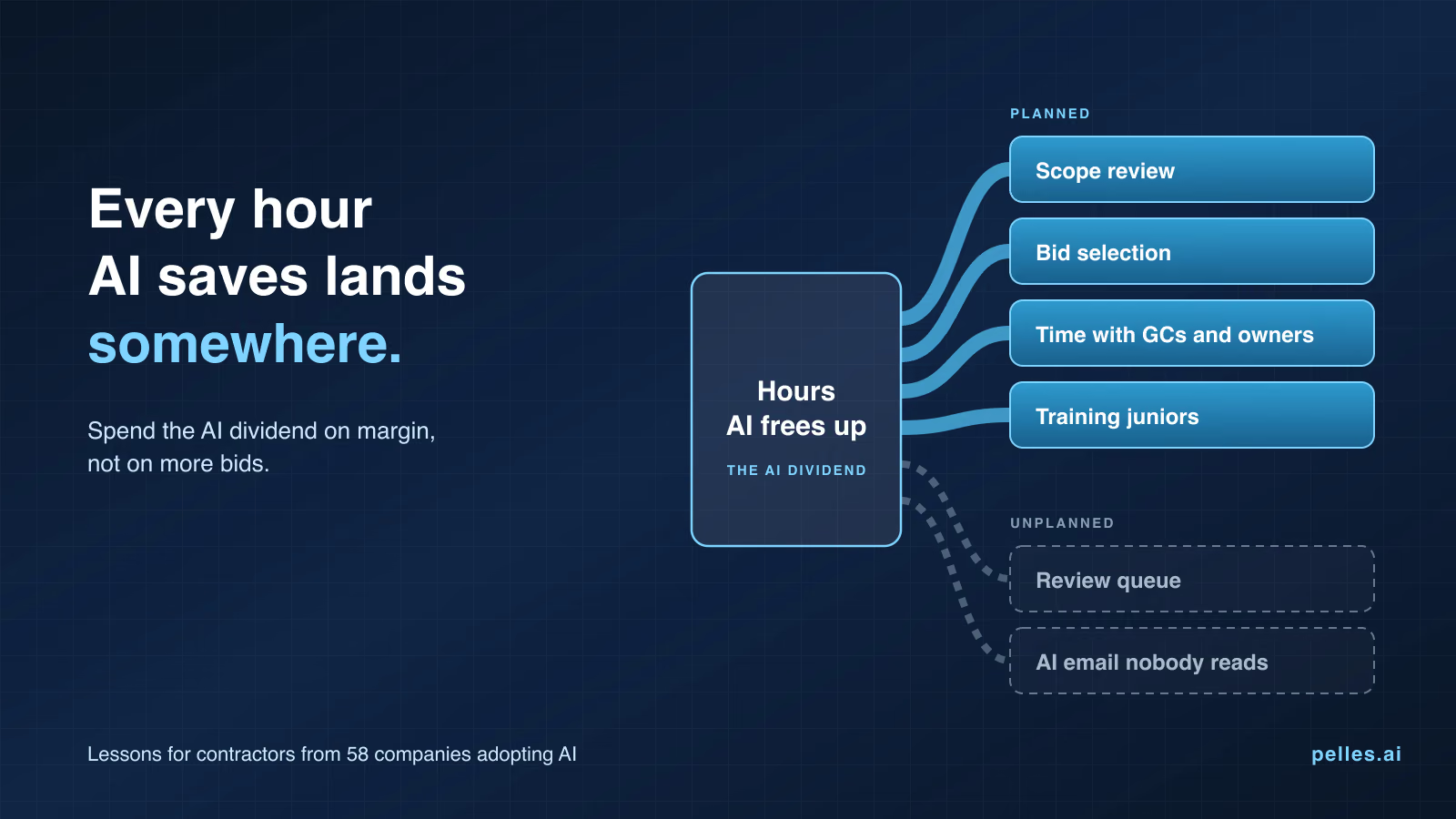
The AI dividend is the time AI frees up across a company: the hours that used to go into takeoff, daily reports, document logging and first drafts. Every firm that adopts AI collects it. What differs is where the hours go. Unplanned, they leak into review queues and unread AI email. Planned, they go into the work closest to the money, which for a contractor means scope review, bid selection, customers and training.
Will AI estimating let a contractor bid more jobs?
Somewhat, but less than the takeoff speed suggests. When AI cuts takeoff time, the constraint moves to whoever reviews bids before they go out, usually the chief estimator. In an illustrative four-estimator team, cutting takeoff from three days to one raises bids that can go out from about 13 to about 16 a month, not 40. Field labor also caps backlog, so the saved hours pay more as tighter scope and better go/no-go decisions.
What is Anthropic's Working with AI report?
Working with AI is a November 2026 report from Anthropic's economics team, written by Nathan Wilmers, Maxim Massenkoff and Peter McCrory. It draws on 66 interviews at 58 US companies, all Anthropic enterprise customers adopting AI, and codes nearly 300 AI applications by reported value and how much organizational change they required. It is qualitative research, and the companies were chosen for variety rather than at random.
Is AI causing layoffs, according to the study?
Rarely. Across 58 companies, only two saw AI eliminate a position outright, and ten hired more because of AI. The larger effect was on hiring: two-thirds reported hiring less, about a third of that by not backfilling people who left and most by growing without adding staff. Nine companies cut contracted or offshore work, which the authors flag as an early warning for outsourced services.