RFI submitted. Response: "See contract documents."
That's not an answer. That's a brush-off. And it happens because the RFI didn't give the reviewer enough to work with.
Here's how to write RFIs that get real responses.
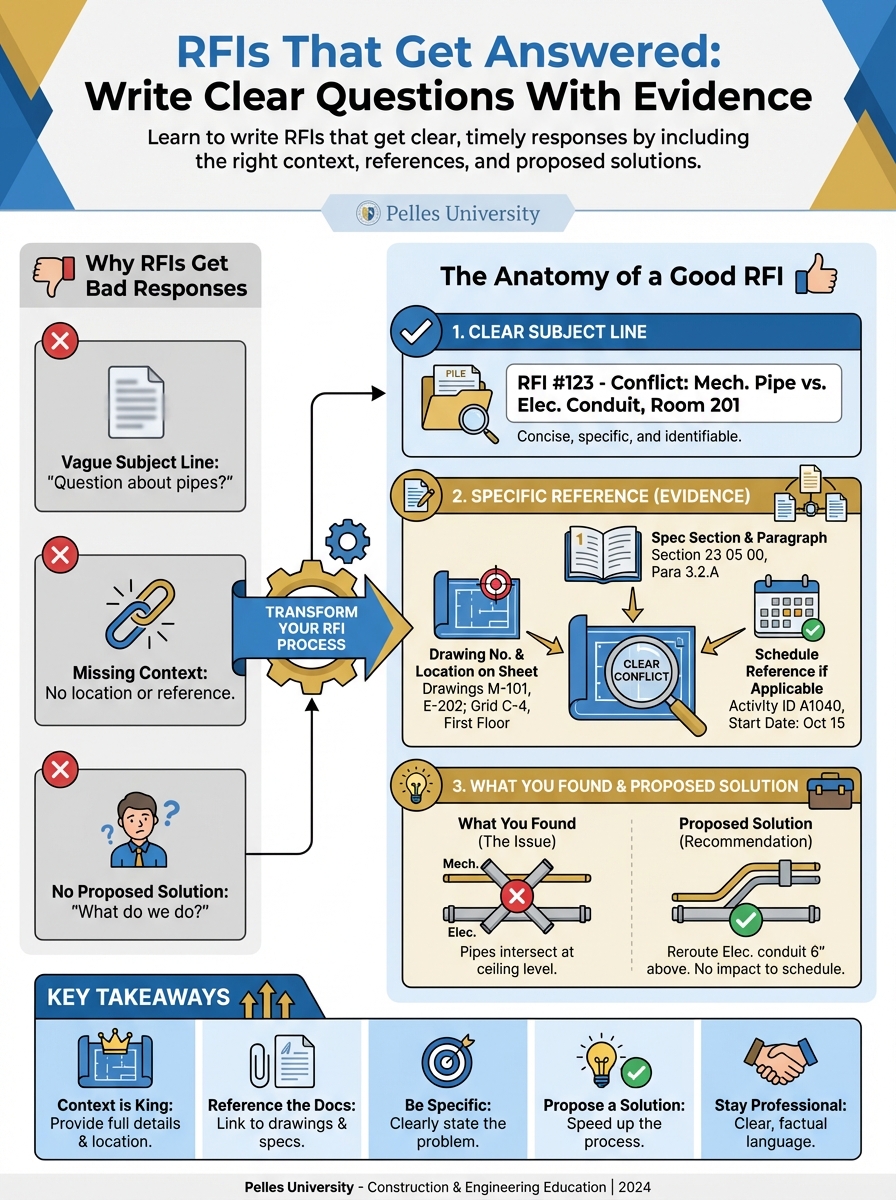
Why RFIs Get Bad Responses
"See contract documents" – Your question wasn't specific enough. The reviewer thinks you didn't look hard enough.
"Contractor to coordinate" – You asked a design question without showing why it's a design issue.
No response at all – Your RFI disappeared into a queue. No urgency communicated.
Answer doesn't address the question – You asked something ambiguous. They answered what they thought you asked.
The common thread: the RFI didn't make it easy to respond.
The Anatomy of a Good RFI
1. Clear Subject Line
Not: "Mechanical question" Yes: "AHU-3 Outdoor Air Damper - Spec vs. Drawing Conflict"
The subject should tell the reviewer what this is about before they open it.
2. Specific Reference
Tell them exactly where to look:
"Drawing M-201, Equipment Schedule, AHU-3 shows 2,500 CFM outdoor air. Specification Section 23 73 00, Paragraph 2.3.1 requires 3,500 CFM minimum outdoor air per ASHRAE 62.1 calculations. Please clarify required outdoor air CFM for AHU-3."
Include:
- Drawing number and location on sheet
- Spec section and paragraph
- Schedule reference if applicable
3. What You Found
Show your work. Explain the conflict or gap:
"We have reviewed both documents and cannot reconcile the difference. The 1,000 CFM delta affects ductwork sizing, damper selection, and energy recovery requirements."
This proves you did your homework.
4. Impact Statement
Explain why this matters:
"Without clarification, we cannot proceed with AHU submittal. Equipment lead time is 14 weeks. Delay in response will impact project schedule."
This creates urgency and priority.
5. Proposed Solution (When Possible)
Make it easy to say yes:
"We propose proceeding with 3,500 CFM per the specification, as this is the more conservative requirement. Please confirm or advise."
Reviewers are busy. If your solution is reasonable, they'll often approve it.
The RFI Template
RFI Number: [Project]-[Sequence]
Date: [Date]
Subject: [Specific topic - location/item - issue type]

TO: [GC/Engineer]
FROM: [Your company]

REFERENCE DOCUMENTS:
- Drawing: [Number, sheet area]
- Specification: [Section, paragraph]
- Other: [As applicable]

ISSUE:
[Clear description of the conflict, ambiguity, or missing information]

IMPACT:
[Why this matters - schedule, cost, or coordination impact]

PROPOSED RESOLUTION:
[Your suggested approach, if applicable]

REQUESTED RESPONSE DATE: [Date]

[Attachments: Marked-up drawings, spec excerpts, photos as needed]
Using AI to Draft RFIs
When you've identified an issue, use AI to help structure the RFI:
I need to write an RFI about [issue description].

Relevant information:
- Drawing [X] shows [Y]
- Spec Section [X] requires [Y]
- The conflict is [description]
- Impact: [schedule/cost/coordination]

Draft a professional RFI that:
1. Clearly references the documents
2. Explains the issue concisely
3. States the impact
4. Proposes a solution if possible

Keep it to one page maximum.
Review and adjust—AI doesn't know your specific project context.
Types of RFIs and How to Handle Them
Design Clarification RFIs
The documents are unclear or incomplete.
Key elements: Show what's missing or ambiguous. Explain what you need to proceed.
Conflict RFIs
Two documents contradict each other.
Key elements: Quote both sources. Ask which takes precedence.
Field Condition RFIs
Something in the field doesn't match documents.
Key elements: Include photos. Show the discrepancy. Propose resolution.
Substitution RFIs
You want to use an alternative product.
Key elements: Follow spec substitution requirements exactly. Include all required documentation.
Clarification of Intent
You understand the words but not the purpose.
Key elements: State your interpretation. Ask for confirmation.
Common RFI Mistakes
Mistake 1: The Multi-Question RFI
Asking five questions in one RFI guarantees confusion. One question per RFI.
Exception: Related questions that must be answered together (e.g., "Is it A or B? If A, then what about X?")
Mistake 2: The Lazy RFI
"Please clarify sheet M-201."
What about it? Be specific or expect "see contract documents."
Mistake 3: The Premature RFI
Asking questions you could answer by reading the documents more carefully. These damage your credibility.
Mistake 4: No Backup Documentation
Claiming there's a conflict but not attaching marked-up evidence. Make the reviewer's job easy.
Mistake 5: No Urgency Indication
Every RFI is "urgent" if you don't indicate real priority. Use dates: "Response needed by [date] to maintain schedule."
Tracking RFI Status
Build an RFI log:
| RFI # | Subject | Submitted | Response Due | Status | Answer Summary |
|---|---|---|---|---|---|
| 001 | AHU-3 OA CFM conflict | 1/15 | 1/22 | Open | - |
| 002 | Chiller room clearance | 1/15 | 1/22 | Closed | Per spec, maintain 36" |
| 003 | Duct penetration detail | 1/18 | 1/25 | Open | - |
Review weekly. Escalate overdue responses.
When RFIs Don't Get Answered
If responses are consistently late:
- Follow up in writing. Document your request.
- Copy the GC. Bring visibility to the delay.
- State the impact. "Without response by [date], [consequence]."
- Request meeting if needed. Some issues resolve faster in conversation.
Document everything. If delays cause cost impacts, you need the paper trail.
What's Next
Good RFI practice prevents disputes. The next step is building RFI templates for common issues—so your team writes consistent, high-quality RFIs without reinventing the format each time.
TL;DR
- Bad RFIs get bad responses—be specific, include evidence, propose solutions
- Reference exact document locations: drawing number, spec section, paragraph
- State the impact: schedule, cost, coordination—create urgency
- One question per RFI keeps responses clear
- Track status and escalate overdue responses with documented follow-ups