Your price is competitive. Your scope is complete. But you're still not winning jobs.
Often, the difference is clarifications. The right clarifications show you understand the project, protect your margin on unknowns, and give the GC confidence you won't be a problem during construction.
Here's how to write clarifications that work.
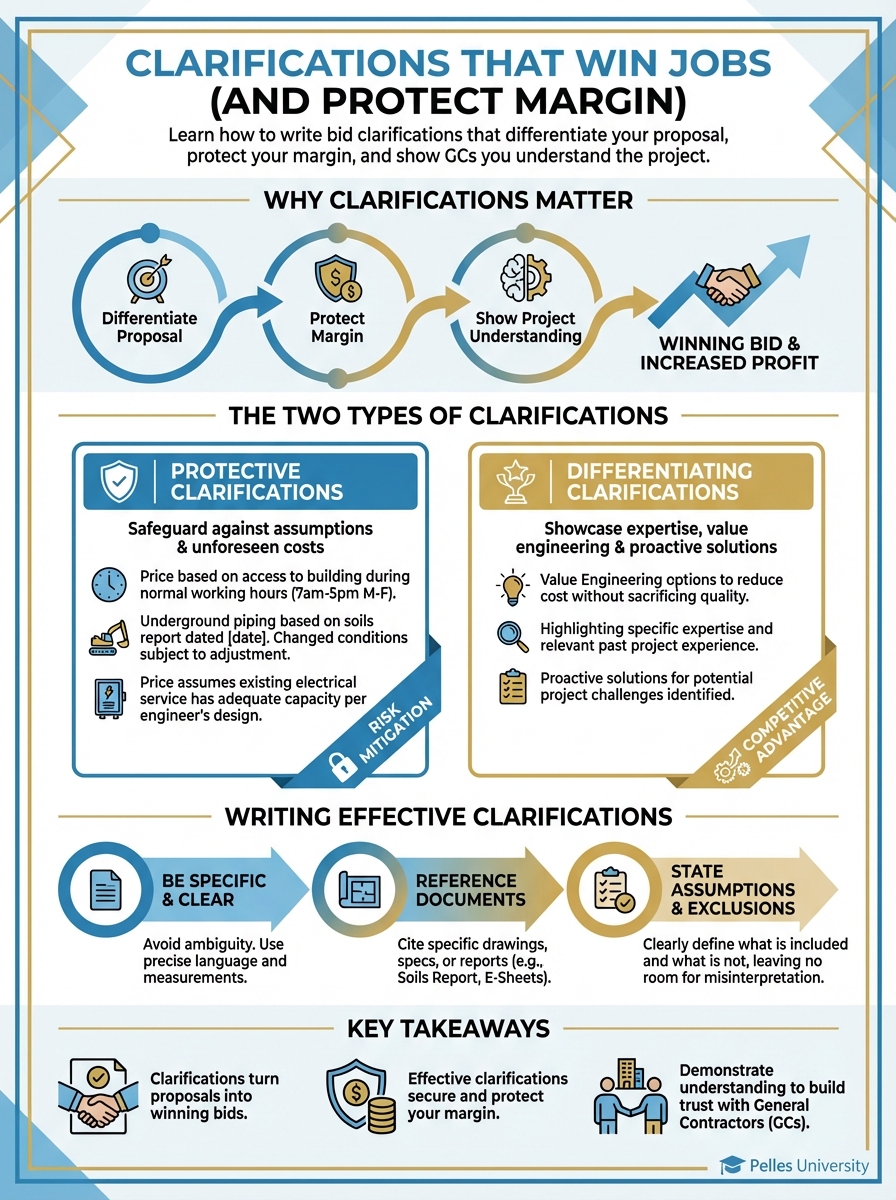
Why Clarifications Matter
GCs and owners don't just compare prices. They compare risk.
A bid with no clarifications says: "We'll figure it out later." That's a red flag. It means RFIs, change orders, and disputes.
A bid with thoughtful clarifications says: "We read the documents, identified the issues, and here's how we're handling them." That's a bidder worth talking to.
The Two Types of Clarifications
Protective Clarifications
These protect your scope and margin. They define what you're including, what you're excluding, and what conditions apply to your price.
Examples:
- "Price based on access to building during normal working hours (7am-5pm M-F)"
- "Underground piping based on soils report dated [date]. Changed conditions subject to adjustment."
- "Price assumes existing electrical service has adequate capacity per engineer's design."
Differentiating Clarifications
These show you've done your homework and understand project-specific challenges.
Examples:
- "We've identified a potential conflict between the return air plenum and structural beam at grid C-4. We recommend early coordination to avoid field rework."
- "Specification calls for equipment from [manufacturer]. Lead time is currently 16 weeks. We recommend early release to meet project schedule."
- "Based on similar projects, we recommend considering VFDs for the chilled water pumps. We've included pricing in Add Alternate #2."
Protective clarifications keep you safe. Differentiating clarifications help you win.
Writing Effective Clarifications
Rule 1: Be Specific, Not Vague
Weak: "Access to work areas assumed." Strong: "Price based on clear access to mechanical room from building completion through startup. If access is restricted or phased, additional mobilizations will apply."
Weak: "Coordination with other trades included." Strong: "Price includes attendance at weekly coordination meetings. BIM coordination includes clash detection for mechanical systems; resolution of clashes by others that impact our systems will be addressed via change order."
Rule 2: Reference the Documents
Show you read the specs and drawings.
Weak: "Equipment as specified." Strong: "Air handling units per Specification Section 23 73 00 and Schedule AHU-1 on Sheet M-201. Unit weights require structural verification at roof locations."
Rule 3: Address Known Unknowns
If something is unclear in the documents, say so.
Example: "Specification Section 23 05 93 requires testing and balancing but does not specify whether TAB is by Division 23 contractor or owner's independent agent. Our price includes TAB by a certified third party. If TAB is by others, deduct $8,500."
This isn't adversarial. It's professional. You're acknowledging uncertainty and providing a clear path forward.
Rule 4: Keep It Scannable
GCs reviewing bids don't read—they scan. Format for skimmability:
Use categories:
- Scope Clarifications
- Schedule Clarifications
- Commercial Clarifications
Use bullets, not paragraphs:
- One clarification per bullet
- Start each with the key topic
- Keep to 1-2 sentences
The Clarifications Checklist
Before submitting, verify you've addressed:
Scope Boundaries:
- Where does your scope end and others begin?
- What's excluded that might be assumed included?
- What owner-furnished items are you installing?
Schedule Assumptions:
- Working hours and days
- Access assumptions
- Equipment lead times
- Phasing assumptions
Site Conditions:
- What site conditions is your price based on?
- Existing system conditions (for renovations)
- Structural or architectural assumptions
Commercial Terms:
- Payment terms assumed
- Change order markup
- Warranty terms beyond standard
Coordination:
- BIM/VDC participation level
- Meeting attendance
- Interface points with other trades
Using AI to Draft Clarifications
After completing your scope review, use this prompt:
Based on this bid package, identify items that should be addressed
in clarifications:

1. Unclear scope boundaries between trades
2. Missing information that affects pricing
3. Unusual requirements that warrant acknowledgment
4. Assumptions we should document
5. Risks we should allocate

For each item, draft a professional clarification statement.
Review the output and customize for your specific pricing decisions.
Common Clarification Mistakes
Mistake 1: Too Many Clarifications
If you have 50 clarifications, you look difficult. Focus on the material ones—issues that affect price or risk.
Mistake 2: Clarifications That Contradict the Spec
"We will provide [alternative product]" when the spec says "no substitutions" isn't a clarification—it's non-compliance.
Mistake 3: Unclear Language
"Normal conditions assumed" means nothing. What's normal? Be specific.
Mistake 4: No Follow-Through
If your clarification says "notify us if X," make sure someone is tracking whether X happens.
What's Next
Good clarifications protect you at bid time. Great clarifications become the starting point for contract negotiations. The next step is building a clarification library—standard language for common issues that you customize per project.
TL;DR
- Clarifications reduce GC risk perception and differentiate your bid from competitors
- Protective clarifications guard your scope and margin; differentiating clarifications show project understanding
- Be specific, reference documents, and address known unknowns directly
- Format for skimmability—bullets, categories, concise statements
- Build a clarification library for common issues so you're not writing from scratch